
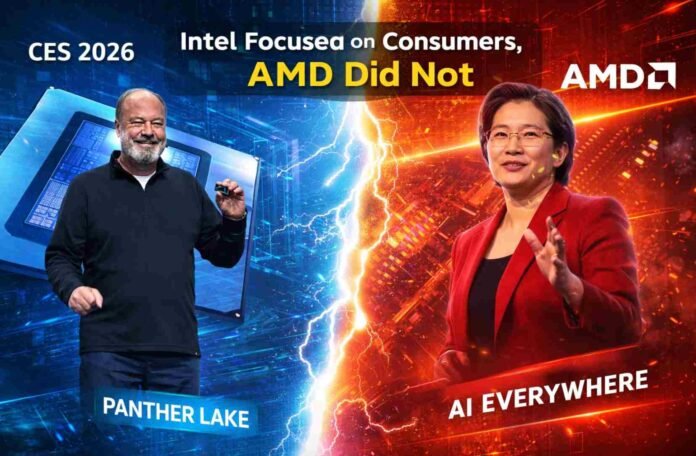
- AMD focused heavily on enterprise AI and gave minimal attention to consumer products.
- Intel delivered a concise keynote centered on clear consumer value with Panther Lake.
- AI messaging resonated more when tied to real user benefits rather than scale.
- CES 2026 highlighted a philosophical shift in how both companies view consumers.
CES may still carry the name Consumer Electronics Show, but in recent years the word “consumer” has felt increasingly symbolic. Artificial intelligence has become the dominant narrative, and while AI is undeniably transformative, its presence at CES 2026 exposed a widening gap between companies that still speak to everyday users and those that seem to have moved on.
This year, that divide was most clearly illustrated by Intel and AMD. Both companies arrived with AI ambitions, but only one made a convincing case for why consumers should care.
AMD’s AI Vision Lost the Consumer Thread
AMD opened CES 2026 with a two hour keynote built around a single idea: AI everywhere. From a business standpoint, the strategy makes sense. AI is driving investor confidence, data center growth, and long term valuation. But for PC enthusiasts and everyday buyers, the message landed hollow.
Consumer announcements existed, but they were buried. Refreshed mobile processors under the Gorgon Point name were mentioned briefly. New Strix Halo SKUs went largely unexplained. Even the Ryzen 7 9850X3D, arguably the most important consumer CPU AMD announced, barely registered in the keynote. These were not absent products; they were sidelined ones.
Instead, much of AMD’s stage time was given to partners whose work has little to do with consumer technology. Executives discussed space missions, national AI strategy, and large scale computing infrastructure. The underlying message was clear, even if unintended: consumers are no longer the priority audience.
That perception was reinforced by what AMD chose not to highlight. A new AI software bundle designed to make AI experimentation easier on Radeon GPUs was omitted entirely. A development box aimed at local AI workloads was framed more as a data center adjacent tool than a consumer gateway.
Even when AMD talked about personal computing, it framed the conversation around shipped compute volume rather than user experience.
AMD is not wrong to pursue data center dominance. Its client and gaming business still generates massive revenue, but its growth narrative is increasingly tied to enterprise AI. The problem is not the ambition.
The problem is the absence of balance. CES is one of the few moments where consumers are listening, and AMD gave them very little reason to stay engaged.
Intel Returned to Fundamentals
Intel’s approach could not have been more different. Its keynote was shorter, tighter, and sharply focused on one product family. Panther Lake was the centerpiece, and everything else flowed from it.
Rather than overwhelming the audience with road maps and geopolitical positioning, Intel explained why Panther Lake matters. It talked about performance, power efficiency, graphics improvements, and real world use cases.
AI was part of the story, but not the entire story. When AI was discussed, it was framed around local execution, privacy, speed, and cost. These are tangible concerns for consumers, not abstract promises.
Intel also showed a level of self-awareness that has been missing for years. Executives openly acknowledged past weaknesses in graphics drivers and performance. That honesty resonated more than any speculative AI forecast. It suggested a company that understands its current position and is working methodically to rebuild trust.
Even Intel’s AI moments were consumer centric. The emphasis on on device AI addressed growing anxieties about cloud dependence, rising memory costs, and massive data center expansion. Intel did not deny the importance of AI; it contextualized it.
Two Philosophies, One Trade Show
What made the contrast so stark was not the number of announcements but the narrative framing. AMD had more to announce, especially on the enterprise side, yet left consumers feeling like an afterthought. Intel had fewer headline products but made a stronger emotional and practical connection.
This does not mean Intel has solved its broader challenges. Its enterprise AI strategy remains unclear, and it lacks the accelerator momentum AMD currently enjoys. But CES 2026 was not about who has the bigger roadmap. It was about who understands the audience in the room.
Intel used CES to explain why its next generation matters to everyday users. AMD used CES to signal where its future revenue lies. Both strategies are valid, but only one aligns with the spirit of the show.
The Cost of an AI First Narrative
AI is not the villain here. The technology is real, powerful, and necessary. But when every keynote becomes an investor pitch, consumers start to disengage. Rising hardware prices, strained power infrastructure, and lingering memories of crypto driven shortages have made enthusiasts wary of hype cycles.
CES 2026 suggested that Intel has recognized this fatigue, while AMD may be underestimating it. Focus does not have to be a zero sum game. A company can chase data center growth without abandoning the people who buy its CPUs and GPUs.
If Intel continues to rebuild around consumer clarity and AMD continues to prioritize enterprise storytelling, the competitive dynamic between the two will shift in unexpected ways. CES did not decide that battle, but it offered a revealing preview.
Follow TechBSB For More Updates