
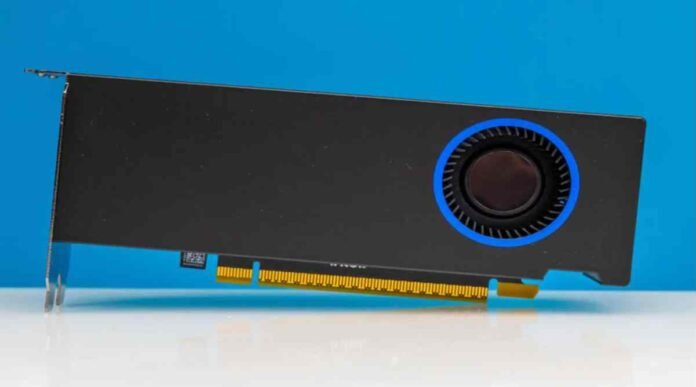
- Delivers usable AI, rendering, and real time engine performance at a low cost
- Ideal for entry level creators, developers, and compact workstations
- Strong efficiency and stability despite modest specifications
- A credible alternative to older Nvidia Ada and lower tier AMD Pro cards
The professional GPU landscape in 2025 has become unusually crowded. Nvidia’s Blackwell launch reset expectations at the high end, AMD refined its Radeon Pro offerings, and Intel quietly continued its slow but deliberate push into professional graphics.
Against that backdrop, the Intel Arc Pro B50 has emerged as an unexpected contender not because it challenges the leaders, but because it delivers just enough capability to matter.
At roughly $300, the B50 is not trying to replace flagship workstation cards. Instead, it targets creators, developers, and system builders who need functional GPU acceleration without the financial or power overhead that modern high end cards demand. That positioning alone makes it worth a closer look.
Real World Performance That Exceeds Expectations
On paper, the Arc Pro B50 does not inspire excitement. Its specifications are modest, and no one would reasonably compare it to Nvidia’s Blackwell class hardware or AMD’s higher tier RDNA3 workstation cards. Yet benchmarks tell a more nuanced story.
In AI workloads, the B50 performs particularly well in first token inference tasks. Single query operations in MLPerf style testing land surprisingly close to what Nvidia’s lower Blackwell SKUs can deliver. Sustained throughput is more restrained, but still competitive with entry level professional GPUs such as Nvidia’s older Ada based cards and AMD’s Radeon Pro W7600.
For creators working in Blender, the B50 completes Cycles renders reliably. It is slower than higher end options, but scenes finish without instability or driver issues. That distinction matters for entry level professionals and freelancers who value consistency over raw speed. The card will not win benchmark charts, but it gets work done.
Real time engines such as Unreal Engine and Unigine also run at playable frame rates. This makes the B50 viable for preview work, visualization, and early stage development. While mid range Ada and Blackwell cards outperform it comfortably, the Intel option remains usable in scenarios where responsiveness matters more than peak frame rates.
Media Creation and AI Assisted Workflows
In creative applications, the Arc Pro B50 shows clear strengths in lighter workflows. After Effects benefits from GPU acceleration in 2D compositions, and DaVinci Resolve handles standard timelines without issue. GPU heavy effects and advanced color grading still favor more powerful hardware, but the B50 allows meaningful progress rather than forcing compromises.
AI driven tools such as Topaz Video AI run steadily, with consistent performance across scenes. Completion times are moderate, yet reliability remains solid. CPU limitations become noticeable in certain AI assisted effects, but that is expected in compact or budget oriented systems.
What stands out is efficiency. The B50’s low power draw allows it to fit into small form factor systems and mini PCs without thermal stress. For experimentation in machine learning inference, video enhancement, or lightweight training, it opens doors that previously required far more expensive hardware.
Value, Trade Offs, and the Competitive Landscape
AMD still offers higher raw throughput at similar price points, particularly for sustained compute workloads. Nvidia’s older Ada generation, meanwhile, has become more attractive as prices soften. Both alternatives remain compelling, especially for users already invested in those ecosystems.
However, Intel’s Arc Pro B50 occupies a niche that neither competitor fully addresses. It offers a balanced mix of AI capability, real time rendering support, and media acceleration at a price that lowers the barrier to entry for professional GPU use.
This is not a card for large scale AI training, heavy offline rendering, or enterprise deployment. It is a pragmatic tool for creators who need acceleration, not excess. Students, freelancers, developers, and compact workstation builders are the clear audience.
Intel’s progress here is less about dominance and more about credibility. The B50 proves that Intel can deliver a functional professional GPU that feels purposeful rather than experimental.
Final Assessment
The Intel Arc Pro B50 does not redefine professional graphics, but it does something arguably more important. It makes professional GPU acceleration accessible. In a market increasingly defined by four figure price tags and rising power demands, that alone gives it relevance.
For users with modest workloads, limited budgets, or space constrained systems, the B50 offers a surprisingly capable foundation. It is not the fastest option available, but it is one of the most practical.
Follow TechBSB For More Updates