
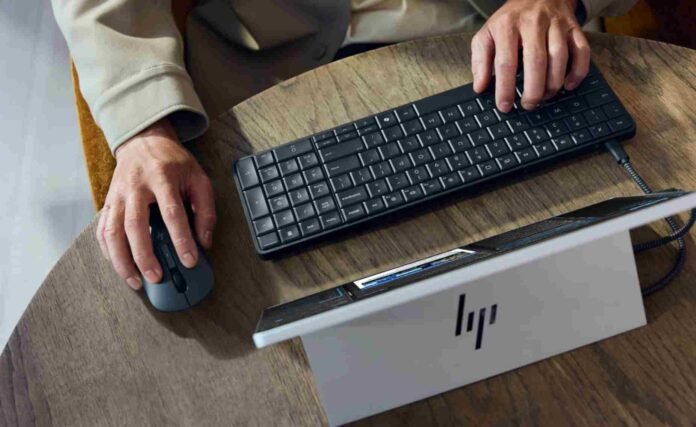
- A full desktop PC is built directly into a compact office keyboard
- Powered by AMD Ryzen AI 300 series processors for productivity tasks
- Supports dual 4K displays, up to 64GB RAM, and 2TB storage
- Designed for clean desks, shared offices, and enterprise environments
At first glance, it looks like an ordinary office keyboard. Slim profile, full layout, understated design. But inside this unassuming slab of plastic and keys, HP has managed to squeeze an entire desktop computer.
Announced at CES 2026, the EliteBoard G1a is not a concept or a novelty demo. It is a fully functional PC designed to live where your keyboard already sits.
The idea sounds quirky, even risky. Yet the more you think about it, the more it makes sense. Desks are crowded. Offices are shrinking. IT departments want fewer boxes, fewer cables, and fewer things to troubleshoot. HP’s answer is radical simplicity. Put the computer where your hands already are.
A Familiar Shape With Unfamiliar Power
The EliteBoard G1a is built into an 1800 layout keyboard, a compact format that keeps a number pad without stretching across the desk. Key travel measures 2mm, which should feel familiar to anyone used to business keyboards. Nothing about typing on it screams “experimental hardware.”
What makes it different is what sits beneath the keys. Inside the chassis is an AMD Ryzen AI 300 series processor, with configurations ranging from the Ryzen AI 5 350 to the Ryzen AI 7 370 Pro.
These chips are not designed to chase gaming rigs or workstation towers. Instead, they focus on efficiency, AI acceleration, and smooth performance for everyday productivity.
The system includes stereo speakers, active cooling with a built in fan, dual SODIMM slots supporting up to 64GB of DDR5 memory, and storage options that go as high as 2TB. In short, this is not a thin client or a glorified terminal. It is a self contained desktop PC that happens to be shaped like a keyboard.
Desk Setup Without the Desk Clutter
Setting up the EliteBoard G1a is almost disarmingly simple. Plug the keyboard into a monitor using USB C, pair the included Bluetooth mouse, and power it on. That is it. There is no separate tower to place under the desk or mini PC to mount behind a screen.
HP says the system supports up to two 4K displays through daisy chaining, making it viable for serious office multitasking. Ports are integrated directly into the keyboard body, keeping essential connectivity within reach rather than hidden behind a monitor or desk panel.
There are two cable options. Buyers can choose a fixed USB C cable or a detachable one, depending on how permanent they want their setup to be. This small choice hints at HP’s broader intent. The EliteBoard is meant to work equally well in hot desk environments, classrooms, shared offices, and controlled enterprise deployments.
Built for Work, Not for Show
This is not a device trying to win over enthusiasts with flashy specs. Instead, it leans into practicality. Optional features include a fingerprint reader for quick and secure sign in, as well as a user replaceable 35Wh battery. That battery provides an estimated three and a half hours of runtime, enough to move between rooms or continue working through short power interruptions.
At roughly 1.69 kilograms, the keyboard is heavier than a standard peripheral but far lighter than carrying a laptop and accessories. For organizations that issue desktops but want some flexibility, this hybrid form could fill an interesting gap.
Performance expectations should be realistic. The EliteBoard G1a will not replace high end desktops used for rendering, data science, or gaming. But for office software, web based tools, light creative work, and AI assisted productivity tasks, the hardware is more than capable.
A Smart Twist on an Old Idea
Computers built into keyboards are not new. Similar ideas have surfaced over the years, often as hobbyist devices or educational tools. What makes HP’s approach different is polish and intent. This is clearly aimed at professional environments, with enterprise grade components, security options, and serviceability.
In many ways, the EliteBoard G1a feels like a response to how work has evolved. People move between desks. Offices prioritize flexibility. IT teams want hardware that is easy to deploy, replace, and manage. By collapsing the computer into the keyboard, HP removes an entire category of physical clutter.
Whether this form factor becomes mainstream remains to be seen. But as a statement, it is confident and surprisingly logical. HP is not asking users to relearn how to work. It is simply asking them to look twice at the keyboard they already use.
Follow TechBSB For More Updates