
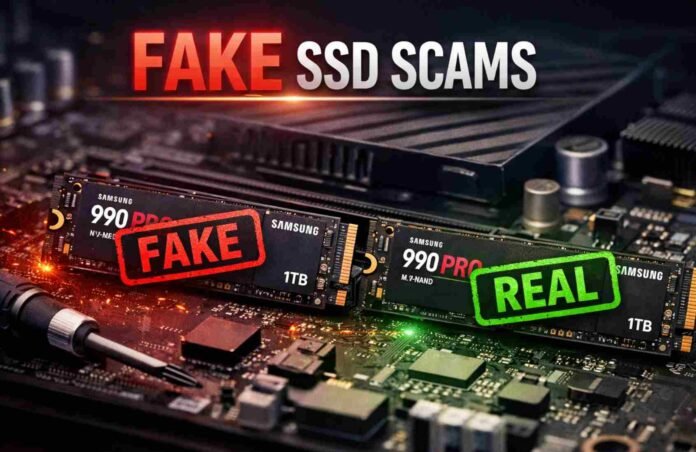
- Fake SSDs can now mimic real products in packaging, capacity, and initial performance
- Sustained workloads reveal major performance drops in counterfeit drives
- Lower quality components like QLC memory are often used to cut costs
- Buying from trusted retailers and testing thoroughly reduces risk
There was a time when spotting a fake SSD was easy. Shoddy packaging, incorrect labels, and laughably poor performance usually gave the game away within minutes. That’s no longer the case. A recent discovery involving a counterfeit Samsung 990 Pro shows just how far scammers have come and why buyers need to be more careful than ever.
This particular fake didn’t just look the part. It behaved like the real thing in ways that would fool even moderately experienced users. The packaging appeared authentic, the labeling was clean and accurate, and once installed, the drive reported the correct capacity. On the surface, there was little reason to suspect anything was wrong.
Even more concerning, it managed to pass basic performance tests. Quick benchmarking tools showed results that were surprisingly close to what you would expect from a genuine high end SSD. For most users, that would be enough reassurance. But beneath that convincing exterior, the truth was very different.
Where the Fake Falls Apart
The illusion starts to crack under sustained workloads. When subjected to longer, more demanding tasks such as transferring large files, the counterfeit drive revealed its limitations. Once its cache was exhausted, performance dropped dramatically, running at a fraction of the speed expected from a legitimate Samsung 990 Pro.
This kind of behavior strongly suggests the use of lower grade components. Instead of the high quality TLC NAND found in genuine drives, scammers are likely using cheaper QLC memory. While this helps them cut costs and increase profits, it severely impacts performance in real world scenarios.
There are also subtle hardware clues for those who know where to look. The controller used in the fake unit does not match what Samsung uses in the actual product. However, identifying such discrepancies requires technical knowledge that most buyers simply do not have.
Why These Scams Are Harder to Catch
What makes this new wave of counterfeit SSDs particularly dangerous is how well they mimic legitimate products. In the past, fake drives often failed at basic functionality. Now, they can pass initial inspections and even simple benchmarks without raising suspicion.
For everyday users, this creates a false sense of security. If a drive installs correctly, shows the expected storage capacity, and delivers decent benchmark results, most people will assume it is genuine. Unfortunately, that assumption can lead to long term frustration once performance issues start to appear.
The rising cost of storage also plays a role. High capacity SSDs have become increasingly expensive, making them attractive targets for counterfeiters. With large profit margins at stake, scammers are investing more effort into making their products look and feel legitimate.
How to Protect Yourself
Avoiding these scams requires a mix of caution and verification. The first rule is simple. Be mindful of where you buy your hardware. Purchasing from reputable retailers significantly reduces the risk of ending up with a counterfeit product. Third party marketplace sellers, especially those offering unusually low prices, should be approached with skepticism.
Once you have the drive, do not rely solely on quick benchmarks. Run more extensive tests that involve sustained read and write operations. These are far more likely to expose weaknesses in fake drives.
Manufacturer tools are another important line of defense. Many brands offer dedicated software that can verify the authenticity of their products. These tools are designed to detect inconsistencies that are not visible through standard testing methods.
If something feels off, trust your instincts. Reach out to the manufacturer’s support team and provide them with the details of your drive. It is better to confirm early than to deal with potential data loss or poor performance later.
Follow TechBSB For More Updates