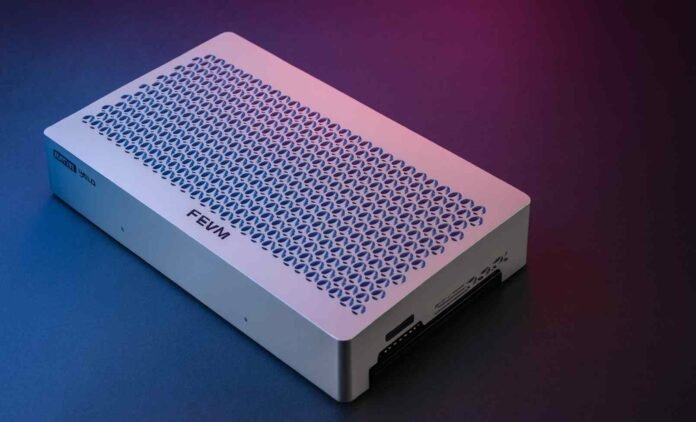
- One liter mini PC with Ryzen AI Max+ 395 and Radeon 8060S GPU
- Soldered LPDDR5X memory in 64GB or 128GB configurations
- Strong I O including USB4, OCuLink, Wi Fi 7, and 10GbE
- Competitive pricing but limited to the Chinese market for now
The FEVM FAEX1 is one of those products that reminds you how far compact computing has come.
In a chassis barely larger than a thick book, FEVM has managed to squeeze in hardware that, until recently, would have required a bulky gaming laptop or a small desktop.
Measuring just 220 x 133 x 35mm and taking up roughly one liter of volume, the FAEX1 is aimed squarely at power users who want extreme performance without sacrificing desk space.
At the heart of the system is AMD’s Ryzen AI Max+ 395, part of the Strix Halo family. This processor features 16 cores and 32 threads, putting it firmly in workstation class territory.
It is paired with AMD’s integrated Radeon 8060S GPU, which FEVM claims delivers graphics performance comparable to a mobile RTX 4070 or what many would loosely call a 5060 class GPU.
That level of graphics capability in a box this small is still rare, even in 2025.
Memory and storage choices favor power over flexibility
One of the most notable design decisions FEVM made is the use of soldered LPDDR5X memory. Buyers can choose between 64GB or 128GB running at 8533 MT/s, but there is no upgrade path later. This will divide opinion.
Professionals who know exactly what they need will appreciate the speed and efficiency of soldered memory, while tinkerers may find the lack of expandability frustrating.
Storage, on the other hand, is impressively flexible. The FAEX1 supports up to three PCIe 4.0 x4 M.2 2280 SSDs. One of these slots is shared with an OCuLink 4i port, allowing users to connect external devices such as discrete GPUs or high speed storage enclosures.
This gives the system a surprising amount of headroom for future expansion, despite its tiny footprint.
Connectivity that rivals much larger systems
Connectivity is one area where the FEVM FAEX1 genuinely stands out. Video output options include HDMI 2.1, DisplayPort 2.0, and USB4, making it suitable for multi monitor setups and high resolution displays.
The USB4 ports also provide up to 15W of power delivery, which is handy for peripherals and portable accessories.
On the networking side, FEVM clearly aimed this device at professionals and enthusiasts. It includes a 10GbE Marvell AQC113 controller alongside a secondary 2.5GbE Ethernet port. Wireless connectivity is handled by a MediaTek MT7925 Wi Fi 7 card with Bluetooth 5.4, which is about as current as it gets right now.
Additional I O includes two USB C 40 Gbps ports, two USB A 10 Gbps ports, an SD 4.0 card reader, and a standard 3.5mm audio jack. Built in stereo speakers and a dual noise canceling microphone array mean the FAEX1 can function as a standalone workstation without immediately reaching for external audio gear.
Cooling, power, and pricing reality
Packing this much performance into such a small enclosure raises obvious questions about heat and sustained performance. FEVM addresses this with an aluminum alloy shell, phase change thermal material, and a dual turbine fan design.
According to the company, the system can sustain a combined CPU and GPU power target of up to 160W, which is ambitious for a one liter PC.
Pricing is competitive for what is on offer, at least within the Strix Halo ecosystem. In China, the 64GB version is priced at 10,999 yuan, roughly $1,550, while the 128GB configuration comes in at 13,999 yuan, or about $1,970.
That undercuts many rival mini PCs using the same processor, which often exceed the $2,000 mark. The catch, of course, is availability.
At the moment, buyers outside China will need to import the FAEX1 or wait to see if FEVM expands distribution.
Follow TechBSB For More Updates