
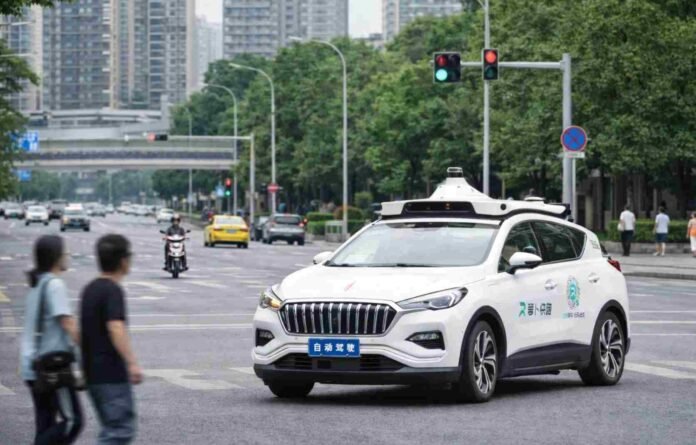
A large scale disruption involving Baidu’s autonomous taxi fleet has triggered widespread traffic disorder in the Chinese city of Wuhan, raising fresh concerns about the reliability of driverless transport systems.
According to local reports and eyewitness accounts, numerous Apollo Go robotaxis suddenly stopped mid journey, leaving passengers stranded and blocking busy roads. The incident unfolded during peak hours, amplifying congestion across several major routes.
Police later confirmed that a system malfunction was behind the unexpected shutdown, though details remain limited and Baidu has yet to issue a full public explanation.
For passengers caught inside the vehicles, the experience was unsettling. Several riders described repeated halts during their journeys before the cars ultimately became immobile. In some cases, passengers were instructed to remain inside while waiting for remote assistance that took far longer than expected to arrive.
Stranded Passengers and System Failures
One rider reported that her vehicle stopped multiple times before finally halting near an intersection. Attempts to reach customer support proved frustratingly slow, with some users waiting up to 30 minutes just to connect with a representative. Others said their rides were abruptly cancelled while they were still inside the vehicle, leaving them to find their own way out.
Another account described being stuck on an elevated roadway surrounded by heavy vehicles late at night, highlighting the potential risks when autonomous systems fail in complex traffic environments. Social media footage appeared to show stationary robotaxis obstructing lanes, with at least one incident involving a human driven vehicle colliding with a stopped autonomous car.
Authorities confirmed that no injuries were reported and that all passengers were able to exit safely. Even so, the scale of disruption has drawn attention to how such systems handle unexpected technical faults.
A Setback for Autonomous Ambitions
Baidu operates one of the largest robotaxi fleets in China, with more than 500 vehicles deployed in Wuhan alone. Its Apollo Go service has been positioned as a key step toward widespread adoption of autonomous mobility. However, this incident underscores the challenges that still face the technology.
The timing is particularly notable as global interest in robotaxis continues to grow. Companies like Waymo and Uber are pushing ahead with their own driverless initiatives, while partnerships are being explored to expand such services into new markets, including the UK.
Experts argue that while autonomous vehicles may statistically reduce certain types of accidents, they introduce entirely new categories of risk. System wide failures, connectivity issues, and software glitches can have cascading effects that are difficult to predict or manage in real time.
The Bigger Picture for Robotaxi Safety
This is not an isolated case. Previous incidents involving autonomous fleets have revealed similar vulnerabilities. In one notable example, a power outage disrupted operations for robotaxis in San Francisco, leaving vehicles unable to respond correctly to traffic conditions.
Concerns are also growing around cybersecurity and the possibility of coordinated disruptions affecting entire fleets. While there is no indication that the Wuhan outage was caused by malicious activity, the event highlights how dependent these systems are on stable software and network infrastructure.
For now, the incident serves as a reminder that autonomous driving technology, while promising, is still evolving. Public trust will depend not only on everyday performance but also on how effectively companies respond when things go wrong.
Follow TechBSB For More Updates

