
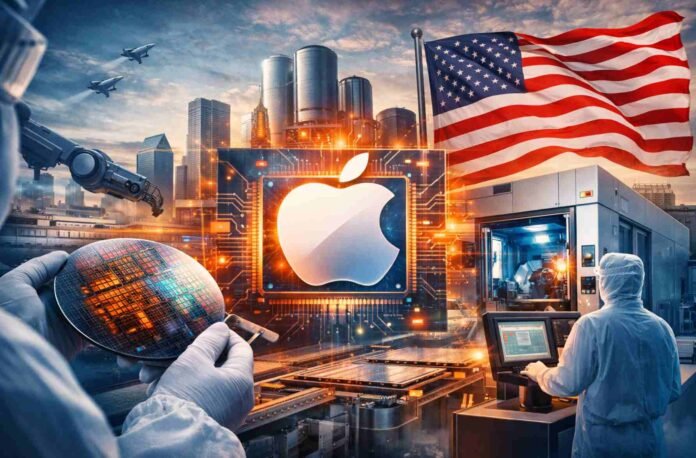
- Apple is helping expand semiconductor manufacturing in Texas and Arizona to reduce supply chain risk.
- Modern chip factories are highly automated and focused on strategic resilience, not mass employment.
- Geopolitical tensions around Taiwan are accelerating US based chip investments.
- The broader tech landscape includes AI policy clashes, new Nvidia chips and major layoffs at Block.
Apple’s long relationship with overseas chip manufacturing is entering a new phase. In Texas and Arizona, the company is quietly helping rebuild a slice of America’s semiconductor muscle. It is not flashy. It is not loud. But it is significant.
On a recent visit to facilities tied to Apple’s US chip push, the future of silicon felt both industrial and surreal. Inside pristine cleanrooms, towering cylinders stretch more than 30 feet into the air, producing massive torpedo-shaped ingots of ultra pure silicon.
Nearby, intricate ceiling-mounted transport systems glide wafers through tightly choreographed production steps. In another room sits a machine worth roughly $400 million that etches patterns onto wafers using extreme ultraviolet light, a wavelength found naturally only on the sun.
This is the bleeding edge of chipmaking. It is also a reminder that reshoring semiconductor production is less about jobs and more about resilience.
Why Apple Is Pushing Chips Back to the US
For years, Apple relied heavily on manufacturing partners in Asia, especially Taiwan. Its close partnership with Taiwan Semiconductor Manufacturing Co helped turn TSMC into the dominant force in advanced chip production. Apple committed to building its most advanced iPhone processors there, anchoring a relationship that reshaped the global chip industry.
But geopolitics have changed the equation. Rising tensions between China and Taiwan have sharpened concerns about supply chain vulnerability. Taiwan remains the epicenter of leading edge chip fabrication, and any disruption would ripple across the global economy.
Apple is not abandoning Taiwan. It is diversifying. By pushing suppliers to build and expand in the United States, Apple is hedging against risk. The company’s investments and purchasing commitments help justify the massive capital outlays required for US based fabs.
Still, perspective matters. Apple’s domestic chip output represents only a fraction of its total demand. The global semiconductor supply chain is vast, complex and deeply interconnected. Building new capacity in the US is measured in decades, not quarters.
Inside the Modern Chip Factory
If you imagine factories as noisy floors packed with workers, modern semiconductor plants will surprise you. They are quieter than expected. Automation dominates. Human workers monitor processes, but machines do most of the heavy lifting.
Silicon begins as purified material formed into enormous cylindrical ingots. These are sliced into thin wafers, polished to atomic smoothness and sent through dozens of steps involving deposition, etching and patterning. The most advanced systems use extreme ultraviolet lithography to carve features so small they are measured in nanometers.
The precision required is almost incomprehensible. A speck of dust can ruin a wafer. Temperature, vibration and air quality are obsessively controlled. The result is a chip capable of powering an iPhone, running advanced AI models or driving high performance computing systems.
Yet for all that technical wizardry, these factories are not job engines in the traditional sense. They employ skilled engineers and technicians, but not in the hundreds of thousands seen in consumer electronics assembly hubs in China. Reshoring chips is about securing strategic capability, not recreating mass manufacturing employment.
The Broader Tech Landscape This Week
Apple’s chip push unfolds against a tense and rapidly shifting tech backdrop.
In Washington, political pressure on artificial intelligence companies is intensifying. President Trump recently announced that the federal government would end its use of models from Anthropic, escalating a dispute over how the company’s AI tools may be deployed by the Pentagon. The move signals a more confrontational posture toward AI providers whose technologies straddle commercial and defense applications.
Meanwhile, Nvidia is preparing to unveil a new processor designed to accelerate AI inference. Unlike training chips, which build large models, inference chips handle real world deployment. A faster, more efficient inference processor could reshape how companies deploy generative AI at scale and potentially reset competitive dynamics in the AI hardware race.
On the consumer front, privacy is emerging as a differentiator. Samsung’s new Galaxy S26 Ultra includes a built in Privacy Display that obscures the screen from prying eyes. It is a small feature with big implications. As phones store ever more sensitive data, hardware based privacy protections may soon feel less like a luxury and more like a necessity. Apple, which has long positioned itself as a privacy champion, may face pressure to match that capability.
Elsewhere, turbulence continues. Block, the payments company founded by Jack Dorsey, plans to cut roughly 40 percent of its workforce. It is a stark reminder that even high profile fintech players are not immune to cost pressures and shifting growth expectations.
A Long Game With High Stakes
Apple’s chip homecoming is not a dramatic repatriation of its supply chain. It is a calculated shift. The company is leveraging its buying power to encourage domestic capacity, knowing that redundancy is insurance in an uncertain world.
Semiconductor manufacturing has always been capital intensive, technically demanding and geopolitically sensitive. Today, it is all three at once, amplified. If the past two decades were defined by efficiency and globalization, the next may be shaped by resilience and strategic redundancy.
Apple’s moves in Texas and Arizona will not transform the industry overnight. But they mark the beginning of a more distributed future for advanced chipmaking. And in a world where silicon underpins everything from smartphones to AI systems to national defense, that shift matters.
Follow TechBSB For More Updates

