
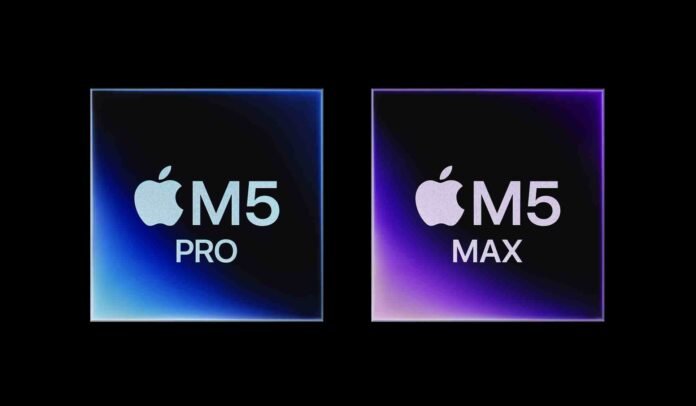
- New Fusion Architecture combines two dies into one powerful SoC for major performance gains.
- 18 core CPU with six super cores delivers up to 30 percent faster pro performance.
- Up to 40 core GPU with Neural Accelerators boosts AI and ray tracing dramatically.
- Up to 128GB unified memory and 614GB per second bandwidth for demanding workflows.
Apple has introduced its most ambitious laptop silicon yet with the M5 Pro and M5 Max, debuting inside the latest MacBook Pro lineup. Built on a new Apple-designed Fusion Architecture, these chips combine two advanced dies into a single system on a chip, unlocking a notable leap in performance while keeping Apple silicon’s hallmark efficiency intact.
This is not a routine spec bump. With a redesigned 18 core CPU, a next-generation GPU that scales up to 40 cores, and a significant increase in unified memory bandwidth, the M5 Pro and M5 Max are clearly engineered for professionals who push their machines to the limit.
Developers compiling massive codebases, 3D artists rendering complex scenes, and AI researchers working with large language models are squarely in Apple’s sights.
According to Johny Srouji, Apple’s Senior Vice President of Hardware Technologies, the new chips reflect Apple’s rapid innovation cycle and its focus on blending raw performance with power efficiency and on device AI.
A New Fusion Architecture Built for Scale
At the heart of both chips is Apple’s new Fusion Architecture. The design connects two third generation 3 nanometer dies into a single SoC using high bandwidth, low latency packaging. Instead of simply increasing clock speeds, Apple has focused on scaling performance intelligently across CPU, GPU, memory, and media engines.
The 18 core CPU features six super cores and 12 newly designed performance cores. The super cores deliver what Apple claims is the fastest single threaded performance in the world, driven by improved front end bandwidth, a new cache hierarchy, and enhanced branch prediction.
Alongside them, the new performance cores are tuned for power efficient multithreaded tasks, ideal for demanding pro workflows.
The result is up to 30 percent higher multithreaded performance in professional workloads compared to the previous generation. Against the M1 Pro and M1 Max, the gains are even more dramatic, reaching up to 2.5 times higher multithreaded performance.
Next Generation GPU With AI at Its Core
The GPU story is just as compelling. The M5 Pro scales up to a 20 core GPU, while the M5 Max doubles that to as many as 40 cores. Each GPU core includes a dedicated Neural Accelerator, dramatically boosting AI throughput.
Apple says peak GPU compute for AI tasks is more than four times higher than the previous generation. Compared to the M1 era, the jump can exceed six times. That kind of uplift is particularly meaningful for professionals working with generative AI models, large datasets, and advanced visual effects.
Graphics improvements extend beyond AI. The enhanced shader core features second generation dynamic caching and hardware accelerated mesh shading. Combined with Apple’s third generation ray tracing engine, the chips can deliver up to 35 percent faster performance in ray traced applications compared to their M4 counterparts.
For 3D artists, video editors, and designers, that means smoother previews, faster renders, and the ability to work with more complex scenes without compromise.
Memory Bandwidth and Pro Workflows
Unified memory remains central to Apple silicon’s advantage, and here too the M5 Pro and M5 Max step forward.
The M5 Pro supports up to 64GB of unified memory with bandwidth reaching 307GB per second. The M5 Max pushes even further, offering up to 128GB of unified memory and bandwidth up to 614GB per second. For professionals handling massive datasets, high resolution video timelines, or large language models, that bandwidth translates directly into responsiveness and reduced bottlenecks.
Apple has also upgraded the 16 core Neural Engine with faster access to memory, improving on device AI features and Apple Intelligence capabilities. The Media Engine supports hardware accelerated H.264 and HEVC, AV1 decode, and ProRes encode and decode, ensuring that video professionals are well catered for.
Thunderbolt 5 support is integrated directly on the chip, with each port backed by its own custom controller. Apple also highlights always on Memory Integrity Enforcement, a security feature designed to enhance memory safety without impacting performance.
Designed for Power and Responsibility
Despite the dramatic performance gains, Apple continues to emphasize efficiency. The M5 Pro and M5 Max are engineered to deliver more compute per watt, helping the new MacBook Pro maintain long battery life while tackling intensive workloads.
The company positions these chips as part of its broader environmental strategy, aiming for carbon neutrality across its footprint by 2030. More efficient silicon means less energy consumption over the lifetime of each device, reinforcing Apple’s sustainability narrative.
In short, the M5 Pro and M5 Max represent a significant step forward for professional laptops. They do not just push benchmarks higher. They expand what creators, developers, and researchers can realistically achieve on a portable machine.
Follow TechBSB For More Updates

