
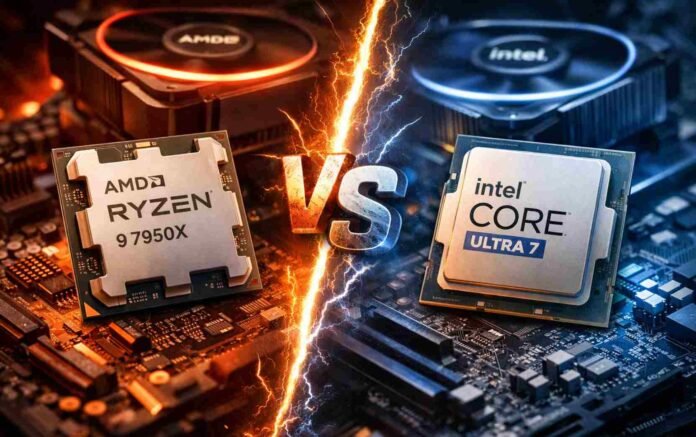
- Intel offers near flagship desktop performance at roughly half the price
- Ryzen 9 7950X advantages only shine in heavily threaded workloads
- Single core and efficiency gains favor Intel for everyday use
- AMD’s premium pricing is harder to justify in today’s market
For most of the last decade, AMD built its desktop reputation on a simple promise. More cores, more threads, and better value than Intel.
That narrative powered Ryzen’s rise and forced Intel into years of uncomfortable catch up. But the latest comparisons at the high end of the desktop market suggest that story is starting to fray.
The Ryzen 9 7950X still looks formidable on paper. Sixteen full performance cores, thirty two threads, and a platform designed to dominate heavy workloads.
Yet when it goes head to head with Intel’s Core Ultra 7 265KF, the outcome is far less decisive than the specifications suggest.
In fact, it raises an awkward question for AMD. When performance gaps shrink to single digits, how much should buyers really pay for theoretical advantages?
When Benchmarks Stop Justifying the Price
Aggregate benchmark scores still give AMD a narrow win. In multi threaded tests, the Ryzen 9 7950X stays ahead, as it should with twelve more threads than Intel’s offering. But the margin is modest, not the runaway victory buyers once expected from a flagship Ryzen chip.
Single thread results complicate things further. Intel’s Core Ultra 7 edges ahead in lightly threaded performance, which is exactly where everyday desktop tasks live.
Web browsing, office work, light creative tasks, and even many games care more about fast individual cores than raw thread count. In those scenarios, Intel’s cheaper processor feels just as responsive, sometimes more so.
This is where AMD’s pricing strategy begins to look uncomfortable. Asking close to five hundred dollars for a processor that only narrowly beats a chip nearly half its price forces buyers to think harder about what they are really paying for. Raw core count alone is no longer enough to carry the value argument.
Efficiency Is Now Part of the Value Conversation
Power consumption used to be Intel’s weakness. That has changed. The Core Ultra 7 runs at a lower rated power draw, and over time that difference adds up.
Lower energy use means less heat, quieter cooling, and lower electricity costs. For enthusiasts who leave their systems running for long hours, those factors matter more than they once did.
AMD’s Ryzen 9 7950X is not inefficient, but it is clearly more demanding. Higher power draw brings higher thermal requirements, which can push users toward more expensive cooling solutions. When performance advantages are small, these secondary costs become harder to ignore.
None of this makes the Ryzen 9 7950X a bad processor. In workloads like 3D rendering, simulation, video encoding, and large code builds, its extra threads still deliver tangible benefits.
Professionals who can consistently saturate all cores will see real gains. The problem is that most desktop buyers do not live in those workloads all day.
Intel’s Familiar Role Reversal
What feels striking about this moment is how familiar it all seems. Years ago, AMD was the scrappy alternative offering near flagship performance for far less money. Intel was the premium brand charging extra for incremental gains.
Today, those roles are not fully reversed, but they are uncomfortably close.
Intel is delivering performance that is good enough in almost every mainstream scenario at a price that undercuts AMD’s high end logic. AMD, meanwhile, is leaning on premium positioning that only makes sense for a narrower slice of users.
The market has changed. Performance scaling has slowed, software is less eager to exploit massive thread counts, and efficiency matters more than ever.
In that environment, charging a steep premium for modest gains is a risky strategy, even for a company with AMD’s recent success.
Follow TechBSB For More Updates

