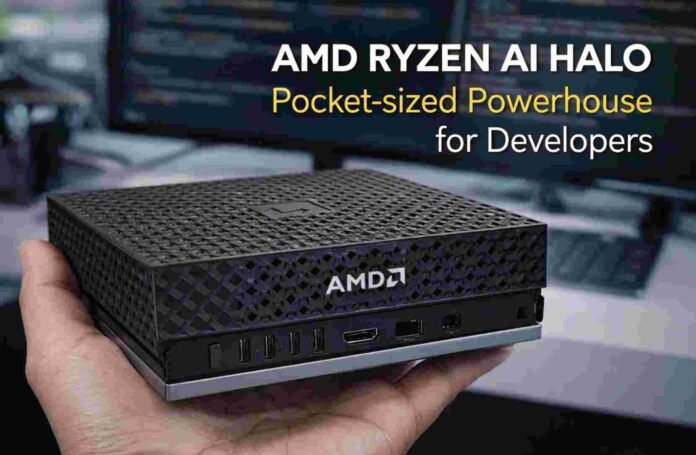
- Ryzen AI Halo is AMD’s compact developer kit built for local AI workloads, not everyday desktop use
- The device is palm sized but includes four USB Type C ports, HDMI, and Ethernet
- It runs on Ryzen AI Max 300 Strix Halo and supports up to 128GB LPDDR5 unified memory
AMD has built plenty of impressive chips over the years, but it rarely puts its own name on the box. That is why Ryzen AI Halo feels like a moment. It is AMD’s most direct statement yet in compact computing, and it is not aimed at everyday buyers who just want a small desktop for email and spreadsheets.
Instead, Ryzen AI Halo is a developer kit designed for people building and testing AI workloads locally. Think of it as a purpose built machine for experimentation, inference, and edge style development, rather than a plug and play home PC.
And yes, it really is tiny. New close up images highlight a device so compact it sits comfortably in the palm of your hand, making most mini PCs look oversized by comparison. AMD is clearly leaning into compute density here, pushing serious performance into a chassis that feels closer to a gadget than a workstation.
Small body, serious connectivity
The first thing that stands out after the size is the lack of compromise in ports. Mini PCs often force you into adapter life, especially if you need multiple displays, fast storage, and wired networking. Ryzen AI Halo avoids that frustration by giving you a surprisingly complete connector lineup right on the device.
You get four USB Type C ports, HDMI, and Ethernet. That is the kind of connectivity you expect from a much larger desktop box, not something that can disappear in a jacket pocket. For developers, this matters. It means fewer dongles on the desk, fewer points of failure, and less clutter when you are moving between workspaces or demo setups.
The design also carries a subtle premium feel. The top surface features a checkered grid pattern that gives it texture and personality, and the AMD branding is present but understated. It looks like a tool made for people who care about hardware, not something dressed up to appeal to casual buyers.
Strix Halo inside, with memory built for AI
Ryzen AI Halo is built around the Ryzen AI Max 300 series, also known as Strix Halo. That platform combines CPU, GPU, and NPU resources in a single package, which is exactly what you want when your goal is running modern AI workloads without leaning on a cloud instance or a full tower GPU rig.
The bigger story, though, is memory. The system supports up to 128GB of LPDDR5 across four channels, and it uses a unified memory approach that lets the GPU tap into a large pool of system memory.
For AI work, that can be a game changer. More accessible memory helps when you are running heavier models locally, working with larger datasets, or simply trying to avoid the constant juggling act of trimming workloads to fit.
This is the kind of configuration that makes sense for developers who want fast iteration cycles and predictable performance. You can prototype and test locally, then decide later whether deployment needs a bigger server class setup.
No Windows, no problem, and no confusion about the audience
AMD is not pretending this is a mainstream Windows mini PC. Ryzen AI Halo ships without Windows or any pre installed operating system, which is a clear signal that this box is meant for people who already know what they are doing. Linux and other supported environments are the natural fit here, especially for AI development stacks.
That choice also keeps the product’s identity clean. It is not trying to replace your office desktop, and it is not being sold as a casual living room PC. It is a compact AI workhorse for developers who want serious compute in a small footprint.
Availability is expected in Q2, and pricing has not been confirmed yet. Still, Strix Halo systems typically land around the $1500 mark and can climb much higher depending on configuration.
The challenge for AMD is that the wider market is already crowded, with dozens of Strix Halo devices in circulation. So AMD’s angle is not just performance. It is the combination of extreme compactness, full connectivity, and flexibility to run the software environment you actually want.
Ryzen AI Halo feels like a deliberate move. It is AMD stepping onto the mini PC stage with its own badge, and doing it in a way that prioritizes developers first.
Follow TechBSB For More Updates