
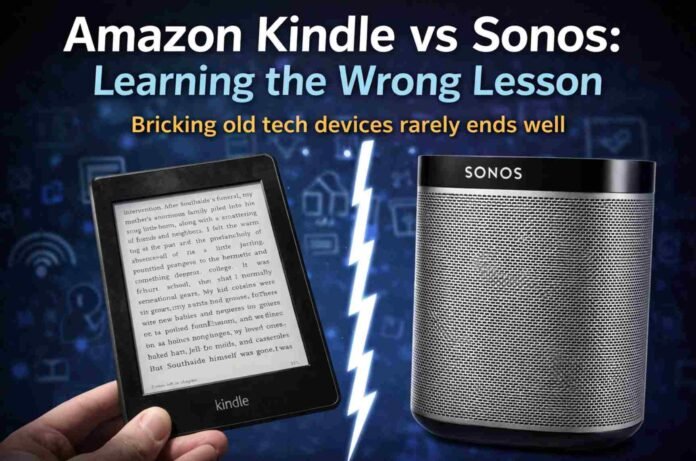
- Amazon plans to end support for older Kindles, frustrating loyal users
- Many affected devices still work, but will lose key functionality
- The move mirrors Sonos’ past mistake with legacy products
- Loss of customer trust may outweigh short term upgrade gains
There is something quietly admirable about a piece of tech that refuses to die. The early Kindle devices were exactly that. Built with surprising durability and simplicity, many of them kept working long after their expected shelf life. That longevity, once a badge of honor for Amazon, is now turning into a problem of its own making.
The company’s recent decision to end support for older Kindle models, particularly those released before 2013, has sparked frustration among longtime users. These are not broken devices. In many cases, they still function as intended. Screens are intact, batteries hold charge, and the core reading experience remains solid. What is being taken away is not the hardware capability, but the ecosystem that made these devices useful.
For users, this feels less like natural technological progression and more like an artificial cutoff.
When great hardware outlives its ecosystem
Consumer electronics are rarely built to last forever. Yet sometimes, companies succeed too well. Early Kindles were robust, minimal, and dependable. Many owners treated them carefully, but even those who did not often found the devices held up.
That creates an unusual situation. When a device still works physically, users expect it to remain usable. Amazon’s move disrupts that expectation by removing essential services such as book downloads. While side loading may remain an option, it is hardly a seamless replacement for the integrated experience that defined Kindle’s appeal.
The frustration is understandable. People are not reacting to broken gadgets. They are reacting to fully functional devices being sidelined by a corporate decision.
A familiar misstep from another tech giant
This situation echoes a past miscalculation by Sonos. Years ago, the company attempted to push customers toward newer speakers by effectively sidelining older models. The backlash was immediate and intense. Users felt pressured into upgrades despite owning perfectly good hardware.
Sonos eventually reversed course. It softened its stance, maintained support longer than planned, and worked to rebuild trust with its audience. That recovery took time. More importantly, it highlighted a simple truth. Customers do not respond well when companies appear to devalue products they once proudly sold.
Amazon now finds itself in a similar position. By limiting functionality on older Kindles, it risks sending a message that longevity is not something to be rewarded.
The hidden cost of lost goodwill
From a business perspective, the number of affected users may not be massive. These are older devices, after all. But the real impact lies elsewhere. Decisions like this chip away at trust.
Kindle has long been associated with reliability and convenience. Users invested not just in hardware, but in an ecosystem of books tied to their accounts. When access to that ecosystem becomes restricted, it creates uncertainty. If older devices can be phased out this way, what guarantees exist for newer ones?
That lingering doubt can influence future buying decisions far more than any single device upgrade cycle.
There is also an emotional component. Many users form attachments to devices that serve them well over years. Removing functionality from those devices feels personal, even if it is not intended that way.
A turning point for Amazon’s hardware philosophy
Amazon still has an opportunity to adjust its approach. Extending limited support, offering clearer alternatives, or improving transition options could soften the blow. More importantly, it could demonstrate that the company values long term customers as much as it values new sales.
The Kindle remains one of the most successful e reading platforms ever created. Its reputation was built on simplicity, durability, and user trust. Decisions like this test that foundation.
If history offers any guidance, it is this. Companies that listen to their users and adapt tend to recover. Those that do not risk repeating mistakes that others have already made.
Follow TechBSB For More Updates