
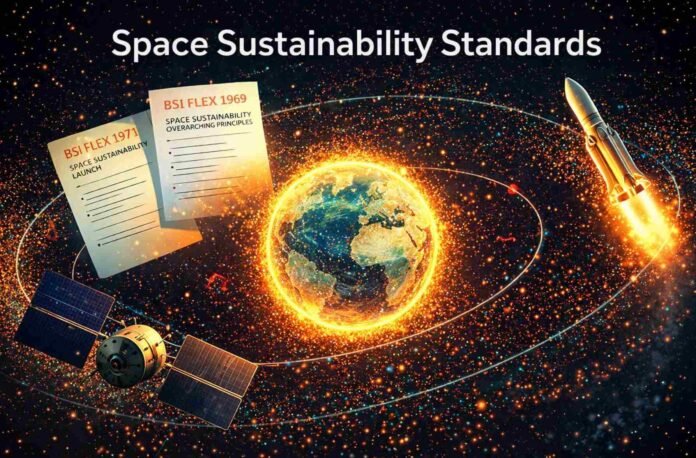
- The UK Space Agency supported updated sustainability standards for space activities.
- BSI Flex 1969 provides ten guiding principles for responsible space missions.
- BSI Flex 1971 introduces clearer environmental practices for launch operations.
- The standards aim to protect orbital space while supporting industry growth.
The rapid growth of global space activity is transforming how humanity communicates, navigates and observes the planet. But with that growth comes responsibility. The orbital environment surrounding Earth is becoming increasingly crowded, raising concerns about space debris, satellite collisions and long term sustainability.
Recognising these challenges, the UK Space Agency has taken another step toward protecting the future of space operations. In partnership with the British Standards Institution, the agency has supported the development and refinement of two important sustainability standards designed to guide responsible behaviour across the space sector.
The newly updated standards aim to help organisations manage the environmental impact of their missions while maintaining innovation and growth within the industry.
Updated Standards for a Growing Space Economy
Two standards sit at the heart of this initiative. The first is BSI Flex 1969, which outlines overarching principles for sustainable space activity. The second is BSI Flex 1971, a more practical framework focused specifically on launch operations.
Both standards were originally introduced to provide early guidance for the rapidly expanding space industry. However, feedback from public consultations, regulators, and industry experts has now led to updated versions that better reflect the realities of modern space missions.
BSI Flex 1969 establishes a broad framework for identifying and managing environmental impacts throughout the entire lifecycle of a space mission. This lifecycle approach begins with spacecraft design and manufacturing, extends through launch and in-orbit operations, and concludes with end-of-life disposal.
The updated version introduces ten simplified principles that organisations can use to guide responsible decision-making. These principles address several critical areas of space operations, including collision avoidance, the mitigation of space debris, and safe rendezvous and proximity operations between spacecraft.
The framework also acknowledges growing concerns about the effect of satellites on astronomical observation. As a result, the principles include goals related to preserving quiet and dark skies, an issue increasingly raised by the scientific community.
Launch Operations Get a Clearer Code of Practice
While BSI Flex 1969 focuses on high level sustainability principles, BSI Flex 1971 delivers more detailed guidance for launch providers and their supply chains.
Launch operations have a unique environmental footprint that extends beyond space itself. They involve complex manufacturing processes, ground infrastructure, fuel usage and regulatory oversight. The updated launch standard has therefore been strengthened into a clearer code of practice.
The revised structure makes the document easier to understand and apply across the industry. It encourages launch providers to identify potential environmental risks earlier in the planning process and to implement mitigation strategies before missions reach the licensing stage.
By addressing sustainability considerations during the early stages of mission development, organisations can reduce regulatory delays while maintaining safety and compliance with national and international rules.
Building Trust While Supporting Innovation
Beyond environmental protection, these standards serve another important purpose. They help establish confidence across the rapidly expanding space economy.
Investors, insurers and regulatory authorities are increasingly paying attention to how companies manage risks in orbit. Demonstrating alignment with recognised sustainability frameworks can make it easier for organisations to secure funding, obtain insurance coverage and navigate regulatory approval processes.
At the same time, the standards are designed to remain flexible. They formalise industry best practices without placing rigid limits on technological innovation. This balance allows companies to develop new capabilities while ensuring that their activities do not threaten the long term usability of space.
The UK Space Agency views these updated standards as part of a broader strategy to promote responsible behaviour across the global space sector. As satellite constellations grow and new commercial players enter the market, clear guidelines will be essential for preventing congestion and protecting the orbital environment.
By supporting the development of practical sustainability frameworks, the United Kingdom aims to position itself as a leader in responsible space governance. The publication of these updated standards represents another step toward ensuring that space remains safe, secure and accessible for generations to come.
Follow TechBSB For More Updates