
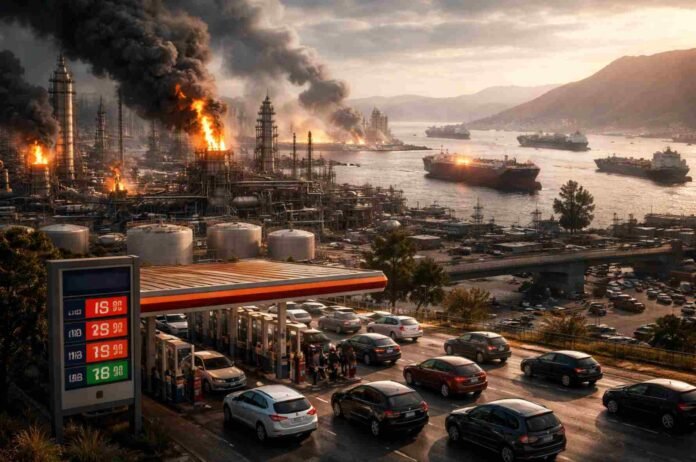
- Strait of Hormuz disruption has cut off major global oil and gas supplies.
- Energy prices have surged, impacting transport, industry, and households.
- Governments are enforcing conservation measures to manage shortages.
- Fertilizer disruption is creating a serious risk to global food supply.
The escalating conflict involving Iran has triggered one of the most severe energy disruptions the world has ever faced. What began as a regional military escalation has rapidly evolved into a global economic shock, with consequences stretching far beyond oil markets.
At the center of the crisis is the Strait of Hormuz, a narrow but critical shipping route responsible for moving roughly one fifth of the world’s oil and liquefied natural gas. Its effective closure has choked off supply at a scale rarely seen in modern history. Within weeks, hundreds of millions of barrels have been removed from circulation, tightening an already strained market.
The result has been immediate and brutal. Prices have surged sharply, forcing governments, businesses, and consumers to confront a harsh reality. There is not enough energy to go around at current consumption levels, and the gap cannot be easily filled.
Prices surge as supply chains break
Oil prices have climbed dramatically since the conflict began, with global benchmarks rising by more than half. In some regions, particularly those dependent on Middle Eastern crude, prices have soared to record levels.
This surge is not limited to crude oil. Refined fuels such as petrol, diesel, and jet fuel are also becoming more expensive, putting pressure on transportation, logistics, and travel. Airlines are already feeling the strain as jet fuel costs spike, with ticket prices expected to follow.
Natural gas markets are equally volatile. Damage to key infrastructure across the Gulf has disrupted production and exports, tightening supply in both Europe and Asia. Power costs are likely to rise, adding further pressure on households and industries already dealing with inflation.
The ripple effects extend into nearly every sector. Energy is a foundational input for manufacturing, chemicals, and even pharmaceuticals. As prices rise, so too does the cost of producing and transporting goods, creating a cascade of economic strain.
Governments scramble to curb demand
With supply constrained and limited options to increase output quickly, many governments are turning to demand reduction measures. The goal is simple but difficult to achieve: use less energy.
Some countries have introduced immediate conservation policies. Public sector travel is being restricted, fuel rationing has been implemented in certain regions, and contingency plans are being activated to stretch available supplies. In some cases, even everyday behaviors are being targeted, such as reducing elevator use or limiting air travel.
International agencies have also stepped in. Emergency stockpiles have been released to stabilize markets, but analysts warn that these reserves are only a temporary buffer. They can soften the blow but cannot fully compensate for the scale of disruption.
The underlying challenge is that this is not a short term imbalance. Infrastructure damage across oil and gas facilities could take years to repair, meaning the supply crunch may persist well beyond the immediate conflict.
A looming threat to global food security
Perhaps the most concerning consequence lies beyond energy markets. The disruption is beginning to hit global food systems, primarily through its impact on fertilizers.
A significant portion of the world’s fertilizer trade moves through the same shipping routes now affected by the conflict. As supplies stall, prices for key inputs such as urea have risen sharply. Farmers in multiple countries are already facing shortages at a critical time in the planting cycle.
This creates a dangerous chain reaction. Reduced fertilizer availability leads to lower crop yields, which in turn reduces global food supply. The impact could extend to staple grains, livestock feed, and eventually meat and dairy production.
Experts warn that even a short extension of the conflict could have lasting consequences for global food security. In many regions, fertilizer costs already represent a large share of farming expenses. Further increases could push production down and prices up, affecting millions of people.
A crisis with no easy exit
What sets this situation apart is its scale and complexity. It is not just an oil shock or a regional disruption. It is a multi layer crisis affecting energy, industry, and food systems simultaneously.
There are no quick fixes. Increasing supply is constrained by both geopolitical realities and physical limitations. Reducing demand, while necessary, comes with economic and social costs.
For now, the world is entering a period of adjustment. Higher prices and lower consumption are becoming unavoidable outcomes. How long this phase lasts will depend largely on how quickly stability returns to one of the most strategically important regions on the planet.
Follow TechBSB For More Updates