- Toshiba plans to introduce 40TB class hard drives between 2026 and 2027
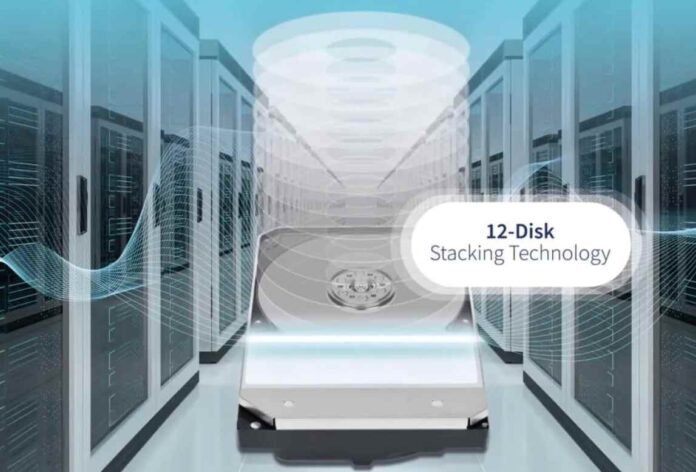
- New designs rely on 11 and 12 glass platters inside standard 3.5 inch drives
- HAMR technology is expected to surpass MAMR in long term density gains
- Capacities of 55TB or more are targeted for the period after 2029
Toshiba has quietly but decisively laid out one of the most ambitious hard drive roadmaps in the industry, signaling that spinning disks still have plenty of room to grow.
Newly revealed internal slides show the company targeting 40TB hard drives within the next couple of years and eyeing 55TB capacities by the end of the decade, driven by major advances in recording technology and platter design.
The roadmap was presented during a recent technology symposium in Japan and later surfaced through local reporting.
It reinforces a broader industry trend. While solid state storage dominates headlines, hard disk drives remain the backbone of hyperscale and archival data storage.
Toshiba is clearly positioning itself to remain competitive as data center demand continues to expand at an unprecedented pace.
From 10TB to 24TB and What Changed Along the Way
Over the past eight years, HDD capacities have steadily climbed. In 2017, a 10TB enterprise drive was considered large. Today, 24TB models are shipping in volume, and Toshiba has played a key role in that progression.
Early gains came from conventional magnetic recording refinements and increasing platter counts. Toshiba moved from seven platter designs to nine and then ten, squeezing more usable surface area into the same 3.5 inch form factor.
The more significant leap came with the introduction of Flux Control Microwave Assisted Magnetic Recording, known as FC MAMR.
By stabilizing the magnetic write process with microwave energy, Toshiba was able to shrink bit sizes without sacrificing reliability. Combined with mechanical improvements and better materials, that approach pushed capacities first to 22TB and then to 24TB by 2024.
Those advances laid the groundwork for what comes next.
Twelve Platters, Glass Media and Two Paths Forward
The most important structural change in Toshiba’s future drives is platter count. The company has already confirmed a 12 platter stacking design for nearline drives, something that had not previously been commercialized.
Achieving this required a shift away from aluminum platters to glass substrates, which can be made thinner while maintaining strength and precision.
Thinner platters allow more disks to fit inside the same enclosure, directly translating into higher total capacity. According to Toshiba’s roadmap, this 11 and 12 platter platform underpins both of its next generation recording strategies.
One path continues with MAMR. Toshiba expects MAMR based drives using 11 or 12 platters to reach the 40TB class around 2027. In parallel, the company is accelerating work on Heat Assisted Magnetic Recording, or HAMR, which introduces a microscopic laser to briefly heat the recording surface during writes.
HAMR enables even smaller magnetic domains than MAMR, opening the door to faster density gains. Toshiba’s slides suggest that HAMR based drives could surpass 40TB as early as 2026 using an 11 platter design, giving the technology a slight timing advantage.
Looking Toward 55TB and the End of the Decade
Beyond 2027, the roadmap becomes more aggressive. Toshiba projects capacities of around 45TB by 2028, with 55TB or more achievable after 2029 as HAMR matures and 12 platter designs reach full production readiness.
The company has also indicated that moving to 13 platters may be technically possible within the same physical format, though that would likely depend on further advances in materials, vibration control and thermal management.
If these targets are met, Toshiba would be delivering some of the highest capacity hard drives ever produced, aimed squarely at hyperscalers, cloud providers and large scale archival deployments.
Despite repeated predictions of the HDD’s decline, the roadmap makes one thing clear. For bulk storage, spinning disks are far from finished.
Follow TechBSB For More Updates