
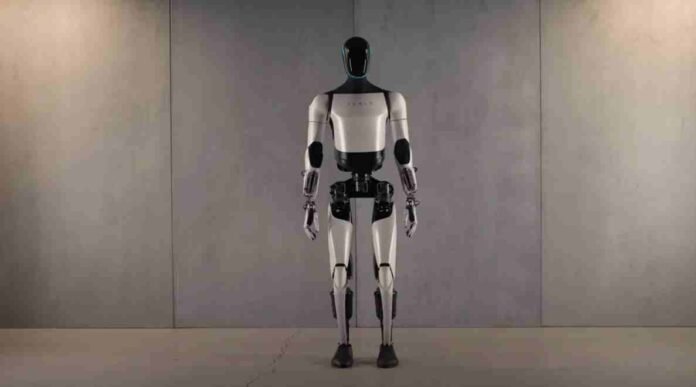
- Tesla claims Optimus 3 will feel nearly human but the visual confusion claim seems overstated
- Musk’s timelines for mass adoption appear overly optimistic
- High cost and safety concerns limit near term consumer use
- Optimus may be more about Tesla’s AI future than household robots
Tesla has never been shy about bold promises, but its latest claims around the Optimus 3 humanoid robot push even Musk era bravado into new territory. Lost in the headlines about Tesla shifting production priorities and struggling EV sales was a much bigger assertion.
According to Tesla’s AI leadership, Optimus 3 may soon look so human that people could genuinely mistake it for a real person.
That statement alone is enough to raise eyebrows. It also opens the door to deeper questions about where humanoid robotics is actually headed and how much of this moment is real progress versus investor friendly storytelling.
From awkward steps to unsettling confidence
Optimus has come a long way in a short time. Early demonstrations were painfully stiff, with a robot that struggled to walk without support. Fast forward a few years and Tesla is now showing off coordinated movement, fluid gestures, and even dance routines that feel designed as much for viral clips as technical validation.
The next leap, according to Tesla, is not just smoother motion but presence. Executives claim Optimus 3 minimizes the differences between robot and human. That is a loaded phrase.
A humanoid robot does not need to fool anyone visually to be useful. In fact, most companies actively avoid that goal. The uncanny valley remains a real problem, and few people want something that looks almost human but not quite roaming around their home.
Optimus still appears to have a featureless, black face and a clearly mechanical body. The idea that someone might confuse it for a person feels exaggerated. What Tesla likely means is that its movement, posture, and responsiveness are approaching human norms rather than its appearance crossing some visual threshold.
Big promises and even bigger timelines
During recent earnings calls and public appearances, Elon Musk framed Optimus as more than a product. He positioned it as an economic force capable of reshaping society. In his vision, mass produced humanoid robots lead to what he calls universal high income, driven by abundance rather than redistribution.
Tesla’s stated goal of producing up to one million robots a year at its Fremont facility feeds directly into that narrative. If robots can work tirelessly in factories, hospitals, and homes, Musk argues that scarcity fades and quality of life rises for everyone.
The problem is timing. Tesla suggests Optimus 3 could arrive as early as March 2026, with consumer scale robots following shortly after. That is an aggressive schedule for a technology that still faces unresolved challenges in perception, safety, autonomy, and human interaction.
Robots operating around vulnerable people like children or the elderly require years of testing, regulation, and cultural adjustment. Hardware improvements and AI training alone do not solve trust.
Elder care, cost, and the reality gap
Musk frequently points to elder care as a key use case, and he is not wrong about the demographic pressure. Aging populations are growing faster than the workforce that supports them. Robots assisting with lifting, monitoring, and routine tasks could make a real difference.
But history offers a cautionary tale. Previous humanoid projects from major companies poured billions into similar goals and quietly stepped away when progress stalled or economics failed to align.
Price is another hard barrier. A robot costing around 30,000 dollars immediately limits adoption. For most households, that is not a helper but a luxury. Those who can afford it may treat it more like a novelty than a necessity.
True mass adoption would require a dramatic cost collapse, possibly down to a few hundred dollars with financing options that feel more like smartphones than cars. Until then, humanoid robots remain aspirational rather than universal.
Competition, China, and strategic smoke
Tesla is not alone in this race. China has poured enormous resources into robotics, and Musk himself acknowledges the scale of that competition. While he expresses confidence in Tesla’s advantages in AI, dexterity, and manufacturing, those claims are difficult to verify from the outside.
This matters because the current moment feels less like a finished product reveal and more like strategic positioning. Tesla is signaling a future beyond EVs, one anchored in AI, chips, and automation. Optimus becomes the symbol of that pivot, whether or not it reaches homes anytime soon.
In the end, Optimus 3 may indeed be impressive. It may even redefine what humanoid robots can do in controlled environments. But the idea that people will confuse it for a human or that it will transform the global economy within a few years feels far more speculative than inevitable.
If that day ever comes, it will not arrive with a dance video or an earnings call soundbite. It will arrive quietly, after years of trust building, price drops, and real world proof. Until then, skepticism remains not only reasonable but necessary.
Follow TechBSB For More Updates

