
Samsung Display is once again investing resources into a display technology that many thought had been shelved. The company has reportedly restarted development of its self emissive QNED panels, a concept that could eventually compete with both OLED and micro LED televisions.
Despite sharing the same acronym, Samsung’s QNED is completely different from the QNED televisions sold by LG. Samsung’s version stands for Quantum dot Nanorod Emitting Diode, and it represents a fundamentally different approach to producing light and color on a TV panel.
Unlike LCD based TVs that rely on a backlight, QNED would be a self emissive display. That means every pixel generates its own light, similar to how OLED panels operate today. The goal is to deliver exceptional contrast, near perfect blacks, and high brightness without the typical limitations of current OLED technology.
Samsung previously paused the project in 2022 while it focused on expanding QD OLED and developing micro LED. However, new progress in nanorod positioning has reportedly convinced the company that QNED deserves another push as part of its long term display strategy.
How Samsung’s QNED works
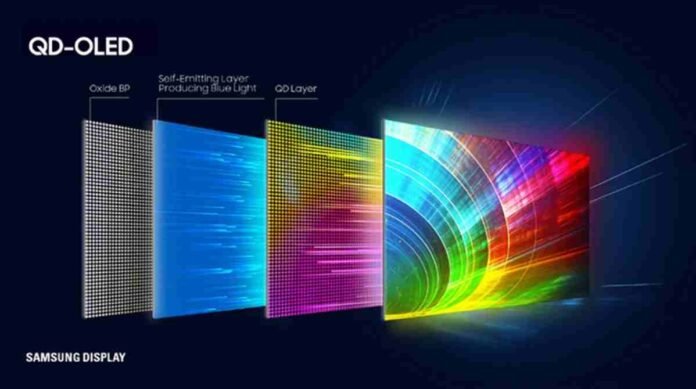
To understand QNED, it helps to first look at Samsung’s existing QD OLED technology.
QD OLED panels use blue OLED light as a base layer. That blue light passes through quantum dots which convert portions of the light into red and green. The result is a full color image produced from a simpler structure than traditional OLED.
QNED aims to follow a similar idea but with a major change. Instead of organic LEDs, it would use inorganic nanorod LEDs. These nanorods act as the light source, producing blue light that quantum dots then convert into the full spectrum of colors needed for the display.
The use of inorganic materials could bring several potential advantages. In theory, these LEDs should last longer than organic OLED compounds. They may also offer higher brightness and better efficiency over time.
Another potential benefit is manufacturing efficiency. Traditional micro LED displays require separate red, green, and blue LEDs for each pixel. QNED simplifies the structure by using only blue emitters while quantum dots handle color conversion. This could significantly reduce the complexity and cost associated with micro LED production.
Why Samsung paused and restarted QNED
Samsung originally explored QNED several years ago but halted development in 2022. At the time, QD OLED was showing strong commercial promise and micro LED was still considered a major future platform.
However, micro LED remains extremely expensive to produce at consumer TV sizes. Manufacturing challenges have slowed its path to mainstream adoption, especially for large displays.
According to reports from Korean industry sources, Samsung made a technical breakthrough in how nanorods are aligned during the production process. Positioning these microscopic structures precisely has been one of the biggest hurdles for QNED development.
With that obstacle partially addressed, the company has reportedly regrouped the team that originally worked on the technology. Internally, Samsung appears to view nanorod LED displays as a long term opportunity worth pursuing alongside its other display innovations.
Where QNED fits in Samsung’s display roadmap
If QNED eventually reaches commercial production, it would join a crowded lineup of advanced display technologies currently under development across the industry.
Samsung Display is already actively producing and improving QD OLED panels, which power some of the company’s flagship TVs. Meanwhile, it continues to experiment with EL QD technology, also known by several names including QD LED and nano LED.
At the same time, manufacturers across the industry are pushing forward with mini LED improvements, RGB backlight systems, and new OLED manufacturing techniques such as inkjet printed OLED.
Micro LED also remains a long term goal for many companies due to its exceptional brightness and durability, though costs remain extremely high.
In that context, QNED could become an interesting middle ground. If Samsung can deliver micro LED style performance with simpler manufacturing, it could create a new category of premium displays that combine the strengths of several existing technologies.
However, it is important to note that QNED televisions are still far from consumer release. Development remains in the research stage, and there is no indication that mass production is close.
Still, Samsung’s decision to restart work on the technology shows that the race to define the next generation of TV displays is far from over.
Follow TechBSB For More Updates