
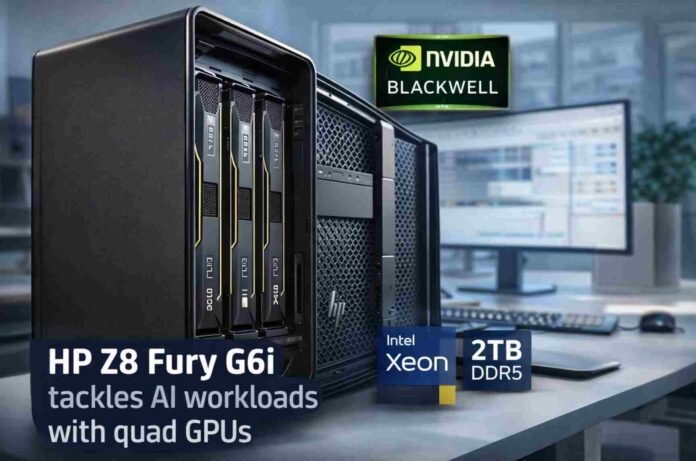
- Supports up to four Nvidia Blackwell GPUs for extreme AI and rendering tasks
- Powered by Intel Xeon CPUs with up to 86 cores and high boost speeds
- Offers up to 2TB DDR5 memory and 104TB storage capacity
- Innovative tool free expandable side panel improves airflow and GPU compatibility
HP has introduced what it claims is its most powerful desktop workstation yet, the Z8 Fury G6i. Built with modern AI development and simulation-heavy workflows in mind, this machine is clearly aimed at professionals who routinely push hardware to its limits.
From advanced rendering pipelines to large scale data modeling, the Z8 Fury G6i is designed to eliminate bottlenecks rather than work around them.
At the heart of the system lies support for up to four high-end professional GPUs based on Nvidia’s latest Blackwell architecture. This alone places the machine in a rare category, as very few workstations are built to handle this level of parallel compute power in a single chassis.
HP is not just chasing raw performance here, it is responding to a shift in how workloads are evolving, particularly in AI and machine learning environments where GPU density matters more than ever.
Built for extreme compute workloads
The Z8 Fury G6i does not stop at GPU muscle. It is powered by next generation Intel Xeon processors that can scale up to 86 cores and 174 threads.
These chips are designed to handle highly parallel workloads, making them ideal for simulations, visual effects production, and complex engineering tasks. Boost speeds reaching 4.8GHz ensure that even single threaded operations remain responsive.
Memory capacity is another standout feature. The system supports up to 2TB of DDR5 ECC memory across 16 DIMM slots, running at speeds up to 6400 MT per second. For professionals dealing with massive datasets or memory intensive AI models, this level of capacity significantly reduces the need for offloading tasks or relying on slower storage layers.
Storage is equally impressive. With support for up to 104TB via multiple NVMe configurations, including front accessible hot swappable drives, the system behaves more like a compact data center node than a traditional workstation. This makes it particularly useful in environments where uptime and rapid data access are critical.
A practical design inspired by real users
One of the most interesting aspects of the Z8 Fury G6i is not just its performance, but its physical design. HP has introduced an optional side panel that can expand the chassis itself. This is not a cosmetic change. It directly addresses a long standing problem faced by professionals who work with oversized GPUs.
In the past, some users resorted to modifying or even cutting their workstation cases to fit newer, bulkier graphics cards. HP’s solution eliminates that need entirely. The expandable panel allows for larger GPUs, including quad wide and high power variants, to be installed without any modifications.
The design is tool free, which simplifies upgrades and maintenance. It also improves airflow and thermal performance by around 15 percent, according to HP. As GPU power consumption continues to rise, efficient cooling becomes just as important as raw compute capability, and this redesign tackles both at once.
Enterprise level expandability and connectivity
The Z8 Fury G6i is built with scalability in mind. It includes nine PCIe slots with support for PCIe 5.0, allowing users to add accelerators, networking cards, or additional storage controllers as needed. Dual power supplies of up to 2700W ensure that even fully loaded configurations can run reliably under sustained workloads.
Connectivity options are equally forward looking. The workstation features Thunderbolt 5, high speed USB ports, WiFi 7, and networking capabilities that can scale up to 100Gb Ethernet. This ensures that the system can integrate seamlessly into modern high performance computing environments.
HP is also expanding its broader workstation ecosystem alongside this release, with additional desktop and mobile systems, as well as hybrid solutions that combine local compute power with cloud resources. This reflects a growing trend where flexibility and scalability are just as important as raw hardware performance.
Follow TechBSB For More Updates

