
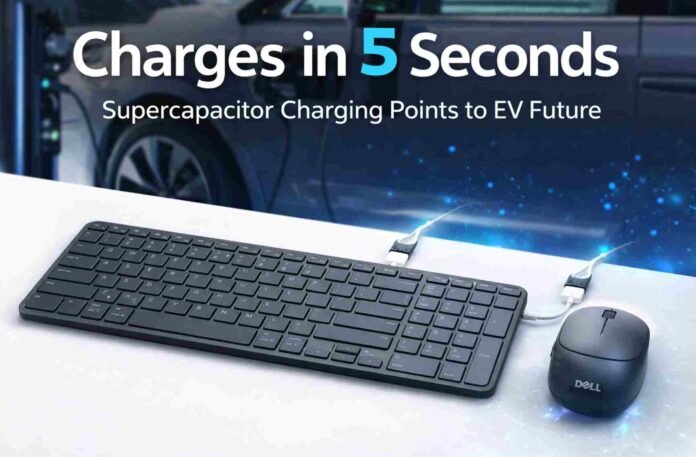
- Dell introduces a keyboard and mouse powered by supercapacitors instead of lithium batteries
- Devices charge in seconds and can last from days to months on a single full charge
- Supercapacitors enable ultra fast charging but store less energy than batteries
- Hybrid systems combining both technologies could shape the future of EVs
Dell has quietly introduced something that feels almost futuristic. Its new Pro 7 rechargeable compact keyboard and mouse swap out conventional lithium-ion batteries for supercapacitors. The result is striking.
A quick five-second top-up can deliver enough power for a full day of use, while a longer charge of under five minutes can keep the keyboard running for months and the mouse for weeks.
That kind of instant readiness challenges what users have come to accept as normal. Charging peripherals overnight or keeping spare batteries on hand has been routine for years. Dell’s approach removes that friction almost entirely. Plug in, wait a moment, and get back to work.
This is not just about convenience. It is about redefining how we think about energy storage in everyday devices.
Why supercapacitors feel like a leap forward
Traditional batteries rely on chemical reactions to store and release energy. That process inherently limits how quickly they can charge. Push them too hard and you generate heat, shorten lifespan, and risk long term degradation.
Supercapacitors work differently. They store energy electrostatically rather than chemically. That allows them to absorb and release energy extremely quickly without the same stress factors.
In practical terms, this means near instant charging and far greater tolerance for repeated charge cycles. Devices become less about planning ahead and more about immediate availability.
Dell has leveraged this strength well. The keyboard offers quiet, office friendly typing, while the mouse remains lightweight without the bulk of a lithium battery. The design clearly targets professionals who move between desks, meetings, and workspaces throughout the day.
The bigger picture for electric vehicles
What makes this launch particularly interesting is not just the peripherals themselves. It is what they hint at for larger technologies, especially electric vehicles.
Today’s EVs rely heavily on lithium ion batteries. Even with fast charging infrastructure, a typical recharge can take anywhere from thirty minutes to several hours. The limitation is not just the charger but the chemistry inside the battery itself.
If supercapacitors could be scaled effectively, they could transform this experience. Imagine charging a car in minutes instead of waiting at a station. The technology also handles rapid energy bursts efficiently, which could improve acceleration and regenerative braking.
However, there is a significant limitation. Supercapacitors do not store as much energy as lithium ion batteries. In a vehicle, that translates to reduced driving range. They also tend to lose stored energy faster when idle.
This is why a full replacement is unlikely in the near term. Instead, the industry is looking toward hybrid systems that combine both technologies. Lithium ion batteries could provide long range endurance, while supercapacitors handle rapid charging and high power demands.
A small device with big implications
Dell’s keyboard and mouse may seem like a niche product, but they serve as a real world demonstration of what is possible. By solving a small everyday problem, they highlight a much larger shift in energy technology.
The idea of waiting hours for a charge may eventually feel as outdated as dial up internet. While supercapacitors are not yet ready to power entire vehicles on their own, their strengths are becoming harder to ignore.
For now, users get a glimpse of that future every time they plug in a device for just a few seconds and walk away with a full day of power.
Follow TechBSB For More Updates