
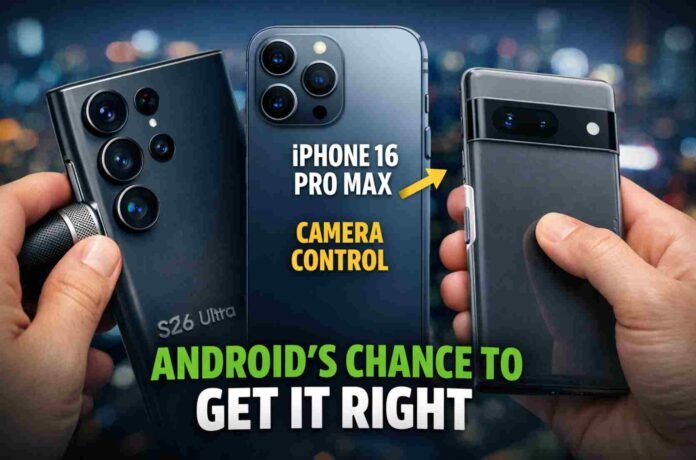
- Apple’s Camera Control button fails to function like a real shutter
- A two-stage shutter improves focus, stability, and shooting confidence
- Android makers can refine the idea faster and more effectively
- Samsung and Google are best positioned to lead this change
Every few years, Apple makes a hardware change so significant that it reshapes the conversation around smartphones. Removing the Home button.
Introducing Face ID. Replacing the mute switch with the Action Button. These moments matter because Apple rarely changes physical controls without long-term intent.
That’s why the introduction of the Camera Control button on the iPhone 16 Pro felt like such a big deal. For photographers, even casual ones, the idea of a dedicated camera button has been a long-standing wish.
Phones have become our primary cameras, yet they still lack the most basic and time-tested control found on real cameras: a proper shutter button.
Unfortunately, Apple’s execution missed the point entirely.
Why a Real Shutter Button Still Matters
Anyone who has used a standalone camera understands the brilliance of a two-stage shutter button. A half press locks focus and exposure.
A full press captures the shot. This simple physical interaction stabilizes the camera, reduces shake, and gives the photographer a sense of control that touchscreens can’t replicate.
Smartphones, by contrast, rely almost entirely on tapping glass. Even with advanced stabilization and computational photography, the act of tapping the screen introduces movement at the worst possible moment.
A physical shutter button solves this problem elegantly, which is why photographers have wanted one on phones for years.
Apple’s Camera Control button could have delivered exactly that. Instead, it became something else entirely.
Where Apple Went Wrong With Camera Control
Rather than behaving like a traditional shutter button, Apple’s Camera Control focuses on secondary adjustments. Zooming. Switching lenses. Tweaking exposure styles. These are functions that already exist on the screen and are often faster to access visually.
Worse, the button is easy to press accidentally. Many users trigger it unintentionally during normal phone handling, which undermines its usefulness.
Focus control, the single most important feature of a shutter button, wasn’t even present at launch and arrived later through software. By that point, the damage was done.
The result is a button that feels more like a solution searching for a problem. It adds complexity without improving the core act of taking a photo. Apple didn’t just underdeliver. It misunderstood why photographers wanted a camera button in the first place.
Why Android Can Get This Right in 2026
This is where Android manufacturers have a real opening. Android phones often take inspiration from Apple, but they’re also more willing to experiment and refine ideas quickly. A physical shutter button done properly would be a meaningful upgrade, not a gimmick.
Google, Samsung, and OnePlus are especially well positioned. Google has already shown a willingness to borrow hardware ideas and improve on them.
Samsung has deep experience blending camera hardware and smartphones, dating back to its ambitious camera-phone hybrids from the early 2010s. Those devices were bulky and imperfect, but they proved Samsung understood how photography-focused hardware could elevate a phone.
Modern components change the equation. Better sensors, smaller optics, faster processors, and smarter software mean a camera-centric phone no longer needs to be awkward or oversized.
A well-designed shutter button with true half-press focusing would instantly appeal to enthusiasts and everyday users alike.
Samsung, in particular, has the credibility to revive this idea. A future Galaxy Ultra device with a real two-stage shutter button would feel purposeful, not nostalgic. It would also differentiate Samsung in a market where phones increasingly look and feel the same.
The Bigger Picture for Smartphone Photography
Smartphone cameras are technically better than ever, yet excitement around them has faded. Incremental sensor upgrades and AI features don’t change how photography feels. Physical interaction does.
A proper shutter button would remind users that photography is about timing, stability, and intention, not just algorithms. It would also signal that phone makers are thinking beyond software tricks and returning to fundamentals.
Apple may eventually correct its course, but Android doesn’t need to wait. If manufacturers act now, 2026 could be the year Android phones finally deliver the camera control photographers have wanted all along.
Follow TechBSB For More Updates