
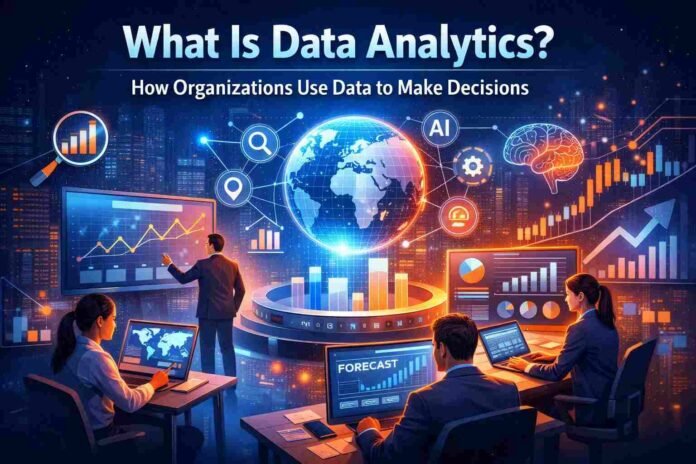
- Data analytics turns raw data into actionable insight
- There are four main types each serving a different purpose
- Strong analytics improves decisions efficiency and growth
- Automation and culture determine long term success
Data analytics is the discipline of turning raw information into meaningful insight that supports smarter decisions. At its core, it is about asking the right questions of data and using proven techniques to uncover patterns, trends, and relationships that would otherwise remain hidden.
After two decades of watching organizations struggle and succeed with analytics, one thing is clear. Data itself has never been the problem. The challenge has always been how to collect it, connect it, trust it, and act on it fast enough to matter.
Modern data analytics goes far beyond static reports and spreadsheets. It enables organizations to analyze information in near real time, combining historical context with current signals to anticipate what is likely to happen next and what actions should be taken.
While data scientists still play a critical role, today’s platforms increasingly empower business users through intuitive interfaces, natural language queries, and automated insights.
When analytics is done well, it becomes part of daily operations rather than a separate technical exercise. It informs pricing decisions, improves customer experiences, reduces risk, and helps leaders move with confidence instead of instinct.
The Four Core Types of Data Analytics
Every analytics initiative should start with clarity around purpose. Over the years, four distinct types of data analytics have emerged, each answering a different class of business question.
Descriptive analytics focuses on understanding what has already happened. This is the foundation of reporting and dashboards. It summarizes performance using metrics such as revenue, volume, or engagement and provides visibility into current and past states of the business.
Diagnostic analytics goes a step further by explaining why something happened. It allows teams to drill into the data, compare variables, and identify root causes. This type of analysis is essential when performance deviates from expectations and leaders need answers rather than assumptions.
Predictive analytics looks forward. By applying statistical models and machine learning techniques, it estimates future outcomes based on historical patterns. Organizations use predictive analytics to forecast demand, anticipate customer behavior, and identify emerging risks before they become problems.
Prescriptive analytics is the most advanced and the most powerful. It not only predicts outcomes but also recommends actions. By testing scenarios and optimizing variables, prescriptive analytics helps decision makers understand which choices are most likely to produce the desired results.
Each type has value on its own, but the strongest analytics programs integrate all four to support decisions across the organization.
Benefits and Real Business Impact
The practical value of data analytics shows up quickly when it is aligned with real business goals.
Better decision making is the most obvious benefit. Analytics replaces guesswork with evidence and gives leaders a clearer view of tradeoffs and consequences. Decisions become faster, more consistent, and easier to justify.
Operational efficiency improves as data reveals bottlenecks, waste, and variation across processes. Whether in supply chains, manufacturing, or service delivery, analytics helps teams focus on the changes that deliver measurable gains.
Customer experience also benefits significantly. Analytics enables personalization at scale, helping organizations understand preferences, behavior, and timing. At the same time, it highlights friction points that cause frustration or abandonment.
From a financial perspective, analytics supports revenue growth and competitive advantage. It uncovers underserved markets, identifies profitable segments, and helps organizations respond more quickly to changes in demand or competition.
Finally, analytics strengthens risk management. By monitoring anomalies and trends, organizations can detect fraud, security threats, and operational risks earlier and respond before damage escalates.
Challenges and the Shift Toward Automation
Despite its promise, data analytics is not without challenges. Data quality issues, fragmented systems, and limited access continue to undermine many initiatives. Skills shortages remain a reality, particularly for advanced analytics and data science roles.
Security and privacy concerns have also grown as regulations tighten and data volumes expand. Every integration point introduces risk, making governance and access control essential.
This is where automation and artificial intelligence are changing the game. Automated data preparation, model selection, and insight generation dramatically reduce manual effort and error. Cloud based platforms allow analytics to scale without the infrastructure burden that once slowed progress.
When analytics is automated and embedded into daily workflows, it becomes accessible to a broader audience. Executives no longer need to wait for specialists. Frontline teams can act on insights as they emerge. The result is faster decisions, fewer mistakes, and greater organizational agility.
The organizations that succeed with analytics understand that technology alone is not enough. They invest in data literacy, encourage curiosity, and build a culture where decisions are grounded in evidence. Over time, analytics stops being a project and becomes a way of working.
Follow TechBSB For More Updates