
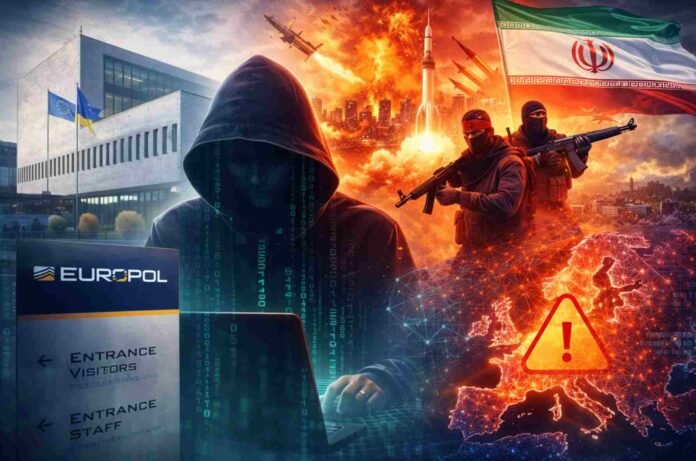
- Europol warns that the Iran conflict could increase terrorism and cyber threats in Europe.
- Groups linked to Iran may attempt to destabilise activities across EU nations.
- Cyberattacks and AI-powered fraud are expected to rise during the conflict.
- Online propaganda could accelerate radicalisation and lone actor attacks.
The escalating conflict involving Iran is now raising serious security concerns across Europe. According to officials from Europol, the European Union’s law enforcement agency, the ongoing war could quickly spill beyond the Middle East and lead to a rise in terrorism, cyberattacks, organised crime, and extremist activities within EU member states.
Authorities believe the instability created by the conflict could embolden extremist networks, encourage lone attackers and fuel online misinformation campaigns that exploit the rapidly spreading information surrounding the war.
Security experts warn that the combination of geopolitical tensions, digital propaganda, and sophisticated cyber tactics could pose immediate risks to European infrastructure and communities.
Europol has warned that groups aligned with Iran, as well as individuals influenced by online radical content, may attempt destabilising actions across the region in the coming weeks or months.
Rising tensions could reshape Europe’s security landscape
The warning comes as the conflict between Iran and Israel intensifies following joint air strikes carried out by Israel and the United States earlier this week. The strikes have significantly escalated hostilities, triggering retaliatory attacks and expanding the scope of the crisis.
European officials fear that the geopolitical shockwaves of the conflict could quickly reach European soil. Intelligence agencies are closely monitoring potential security risks that may emerge from the Middle East war.
Europol spokesperson Jan Op Gen Oorth said the conflict is likely to have immediate repercussions for security within the European Union. According to him, the risk environment across Europe is already elevated, and the ongoing war could amplify existing threats.
Authorities expect extremist groups or networks connected to Iran to potentially carry out destabilising actions in Europe. These actions could range from direct attacks and intimidation campaigns to financial support for militant groups and cybercrime operations.
Security analysts warn that Europe has historically faced spillover effects from conflicts in the Middle East, particularly when extremist groups use international crises to mobilise supporters or recruit new followers.
Cyberattacks and AI driven scams expected to rise
One of the biggest concerns highlighted by Europol involves cyber threats. Officials believe the conflict will likely trigger a surge in cyberattacks targeting European infrastructure, institutions and businesses.
Cybercriminals are expected to take advantage of the chaotic information environment surrounding the conflict. Fake news, manipulated content and emotional narratives spreading online can create opportunities for fraud and hacking campaigns.
Europol warns that criminals are increasingly using advanced artificial intelligence tools to launch more convincing scams. These tools allow attackers to produce realistic messages, fake videos and sophisticated phishing campaigns that are harder for people to detect.
Critical infrastructure, financial institutions and government systems could become potential targets if cyber groups attempt to disrupt services or cause political instability.
Law enforcement agencies across Europe are therefore preparing for a possible increase in digital threats linked to the geopolitical crisis.
Risk of radicalisation and lone actor attacks
Another concern for security agencies is the rapid spread of polarising content on social media platforms. Europol officials believe that online narratives surrounding the war could accelerate radicalisation among certain individuals.
The internet allows propaganda and emotional messaging to spread quickly, often reaching diaspora communities and vulnerable individuals who may already feel politically or socially alienated.
According to Europol, this environment can create conditions where individuals radicalise within a short period of time. In such cases, attacks may be carried out by lone actors or small independent cells rather than organised networks.
These types of attackers are particularly difficult for authorities to detect in advance because they often operate without direct instructions from established terrorist groups.
Security agencies across the European Union are therefore increasing monitoring efforts and strengthening cooperation between intelligence services to detect potential threats early.
Conflict in the Middle East intensifies global security concerns
The warning from Europol comes as the Iran Israel conflict enters its sixth day, with both sides continuing to exchange military strikes.
The escalation began after joint Israeli and US air strikes targeted Iranian positions during the weekend. The attacks reportedly killed more than a thousand people and triggered a major response from Iran.
In retaliation, Iran has launched attacks against regional targets, including neighbouring countries such as Qatar and the United Arab Emirates, as well as key energy infrastructure and shipping routes.
The death of Iran’s Supreme Leader during the escalation has further intensified tensions and raised fears that the conflict could widen into a broader regional confrontation.
European security officials now worry that the instability created by the war could encourage extremist networks, cyber groups and criminal organisations to exploit the chaos for their own agendas.
For Europol and EU member states, the priority now is to remain alert to emerging threats and prevent the conflict’s ripple effects from undermining security within Europe.
Follow TechBSB For More Updates