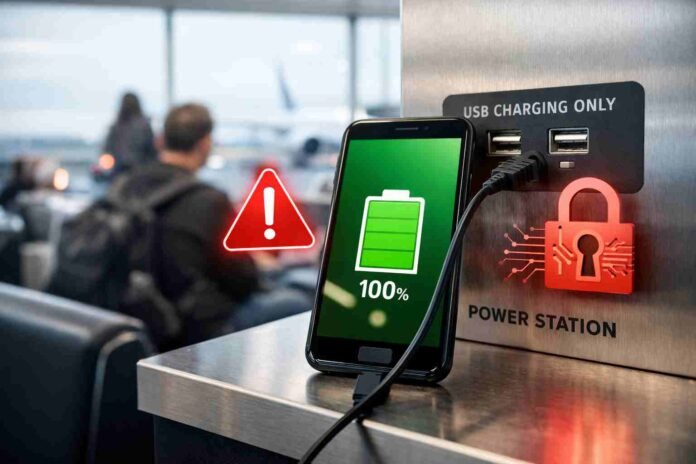
- Use your own cable whenever possible
- Never approve trust prompts on unknown chargers
- Keep your phone software fully updated
- Public charging is usually safe but caution matters
Few things trigger faster decision making than a dying phone. When the battery warning flashes red, logic tends to take a back seat. You grab the nearest cable, plug into an airport seat, a café outlet, or a rideshare port, and hope for the best.
But that moment of convenience raises a real question. Can public charging cables or USB ports compromise your phone and your data?
The short answer is yes, but not in the way social media panic often suggests. The longer answer is more reassuring and more useful.
What Juice Jacking Actually Means
Juice jacking is not a myth, but it is often misunderstood. The idea is simple. A USB cable or charging port is capable of carrying power and data. If a malicious actor controls the cable or port, they could attempt to access the connected device.
In earlier smartphone generations, this was easier. Plugging into a compromised port could expose files, contacts, or even allow malware installation without much resistance.
Today, attacks rely on modified hardware. Some cables contain tiny embedded chips that can attempt to communicate with your device once connected. These are not everyday cables. They are purpose built tools designed to exploit trust or outdated systems.
The important distinction is this. The cable itself is the risk, not the act of charging. Power alone is harmless. Data transfer is where exposure happens.
Why Modern Phones Are Much Harder to Hack
Smartphones in 2026 are significantly more defensive than their predecessors. Apple and Android devices now block data connections by default when plugged into an unknown source. Charging is allowed. Communication is not.
When you connect your phone to a new USB device, the system typically asks for permission. Prompts like Trust This Device or Allow Data Access exist for a reason. If you do nothing, the phone remains in charge only mode.
This means that a malicious cable cannot simply take control. It has to convince the user to approve access or exploit an unpatched vulnerability. That raises the technical barrier dramatically.
Security updates also matter. Phones that are regularly updated close off known attack paths. The majority of successful juice jacking demonstrations rely on outdated software or user approval.
In practical terms, this means the risk is real but situational. It is far less common than phishing or malicious apps and far easier to avoid with basic awareness.
Where the Risk Still Exists
Despite improvements, some scenarios deserve caution.
Borrowed cables from strangers remain the biggest wildcard. You cannot see what is inside a cable, and malicious versions are cheap and easy to obtain online.
Public USB charging ports also introduce uncertainty. Even if the cable is yours, the port itself may be connected to a computer or intermediary device rather than a simple power supply.
Older devices and work phones with relaxed security policies are also more vulnerable. Corporate devices often allow broader access for legitimate reasons, which can increase exposure if misused.
Finally, user behavior still matters. Granting trust prompts without thinking defeats built in protections.
How to Charge Safely Without Overthinking It
Safe charging does not require paranoia. It requires consistency.
Use your own cable whenever possible. If you need to buy one while traveling, choose a sealed package from a reputable store.
Avoid tapping trust or allow when connecting to unknown power sources. If your phone asks for permission, stop and reconsider.
Keep your phone updated. Security patches quietly do most of the work.
If you travel frequently, consider a USB data blocker. These inexpensive adapters physically prevent data transfer while allowing power through.
And if you are handling sensitive information, avoid doing so while connected to public charging points.
Follow TechBSB For More Updates