
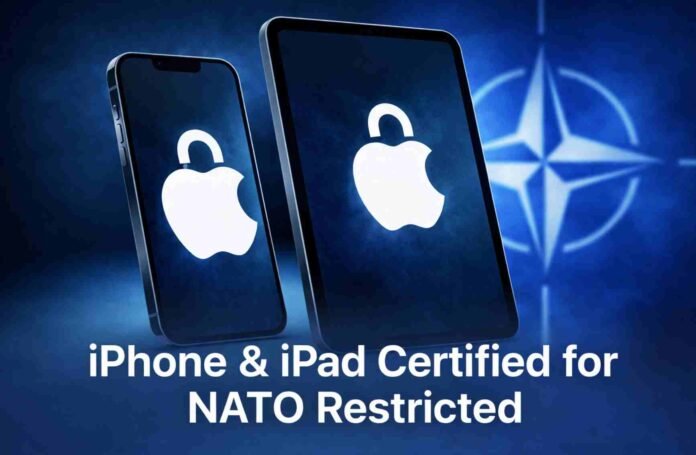
- iPhones and iPads running iOS 26 and iPadOS 26 are approved for NATO Restricted data.
- No special software is required beyond supervised device management.
- Certification followed rigorous testing by Germany’s BSI.
- New M5 and A19 chips offer enhanced memory safety protections.
Apple’s iPhone and iPad have reached a milestone no other mainstream mobile devices have achieved. Devices running iOS 26 and iPadOS 26 are now approved to handle information classified up to NATO Restricted level, marking the first time consumer hardware has met this threshold.
The approval appears in NATO’s Information Assurance Product Catalogue, which lists eligible Apple devices operating under what NATO calls the indigo configuration. Crucially, this status does not require any custom firmware, hardware modifications, or specialist editions. Standard, commercially available iPhones and iPads qualify when properly managed through a device management service.
In simple terms, governments within NATO can now deploy off the shelf Apple devices for specific classified workflows without altering the software stack. That is a remarkable shift in how consumer technology intersects with national security infrastructure.
No Special Version Required
One of the most striking aspects of the certification is what it does not involve. NATO confirmed that indigo does not require additional software beyond device supervision and management. There is no separate hardened operating system build and no restricted distribution model.
Apple emphasized that it did not design a NATO specific product. Instead, the company maintains that its broader security architecture already meets extremely high standards. According to Apple’s security leadership, the same protections built for everyday users are the ones now certified for NATO environments.
That argument rests on a layered approach to security. Apple points to end to end encryption, biometric authentication through Face ID, and system level safeguards such as Memory Integrity Enforcement. The company also highlights the Secure Enclave embedded within Apple silicon, which isolates sensitive operations like key management and biometric data processing.
The certification process itself was conducted by Germany’s Federal Office for Information Security, known as BSI. Following an extensive evaluation of iOS and iPadOS platform security, BSI confirmed compliance with NATO assurance requirements for classified German information systems.
Broad Device Support, With a Nod to New Chips
The approval applies to iOS 26 and iPadOS 26, both of which support a wide range of hardware. On the iPhone side, compatibility stretches back to the iPhone 11 lineup and the second generation iPhone SE. That means older devices in active service are not automatically excluded.
However, NATO documentation and Apple commentary give particular attention to newer hardware. The latest M5 and A19 chips are mentioned for their always on memory safety protections and architectural advances. While the certification technically covers supported devices, it is clear that the newest silicon offers additional layers of resilience.
This suggests that while agencies can continue using older approved models, future procurement decisions may lean toward the most recent chip generations for long term deployments.
What “NATO Restricted” Actually Means
NATO Restricted is the lowest tier within NATO’s classified information framework, but it still represents sensitive material. Information at this level, if disclosed without authorization, could cause damage to NATO interests.
Certification does not turn an iPhone into a universal classified terminal. Instead, it confirms that, within defined configurations and management controls, the platform can securely handle specific categories of data such as mail, calendar, and contacts associated with classified environments.
It is also important to understand the broader implication. For years, consumer devices have been viewed with skepticism in high security circles. Specialized, government issued hardware often dominated. This approval signals growing confidence in hardened commercial platforms, particularly those with vertically integrated hardware and software design.
Apple’s approach of controlling both silicon and operating system likely played a major role in achieving this milestone. The tight coupling between hardware security features and software enforcement mechanisms offers a level of predictability and auditability that regulators appear comfortable certifying.
A Strategic Win for Apple
While Apple insists that its goal is to build secure devices for everyone rather than for specific institutions, the optics are significant. Being the first consumer mobile platform cleared for NATO Restricted data sets Apple apart from competitors in both public sector and enterprise markets.
For government buyers across NATO nations, this reduces friction. Instead of investing in niche devices, agencies can potentially standardize around hardware already widely deployed among staff.
For the wider industry, the message is equally clear. Consumer grade no longer automatically means consumer level security. The line between public and classified capable hardware is beginning to blur.
Follow TechBSB For More Updates