
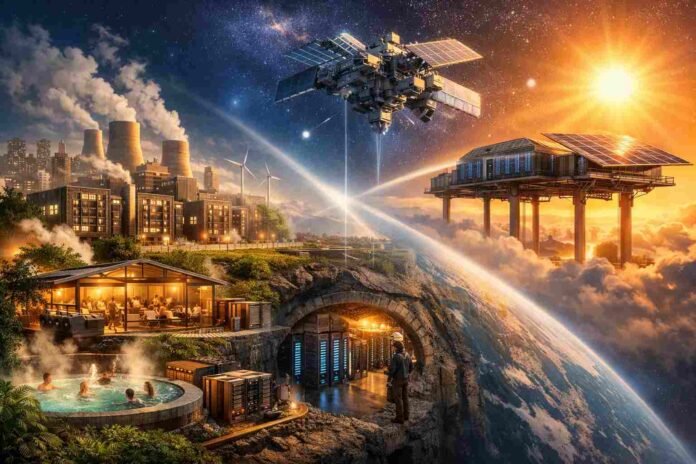
For most of its history, cloud computing has been built on a simple assumption. If demand grows, you add more servers, find more land, and secure more power. That assumption is now breaking down.
Artificial intelligence has changed the math. Training and running modern AI models consumes vast amounts of electricity and water, pushing data centers from being quiet background infrastructure into some of the most energy intensive industrial assets on the planet.
In many regions, power grids are already strained, permitting timelines are slowing, and communities are increasingly resistant to hosting facilities that offer few visible benefits.
The result is an emerging reality that many in the industry have been slow to acknowledge. The data center designs that powered the last two decades of digital growth are approaching their limits.
Industry leaders now speak openly about a coming inflection point. The question is no longer how fast data centers can scale, but whether they can do so at all without fundamentally changing their relationship with energy, land, and society.
When Traditional Data Centers Stop Making Sense
Conventional data centers were optimized for reliability and security, not for sustainability or integration with local communities. They draw enormous power, generate significant waste heat, and often sit behind blank walls that symbolize exclusion rather than participation.
Recent industry research shows a growing disconnect. While most technology decision makers say energy efficiency is now a priority, fewer than half believe their existing facilities can realistically meet long term sustainability goals. That gap is widening as AI workloads push server density and cooling requirements higher than most legacy designs can handle.
This is not simply a technical challenge. It is also regulatory and social. Power utilities are struggling to meet demand. Governments are tightening environmental standards. Local residents are questioning why data centers consume so much while offering little beyond tax revenue and a handful of jobs.
These pressures are forcing operators and hardware vendors to explore ideas that would have seemed impractical or unnecessary just a few years ago.
Data Centers That Give Something Back
One emerging concept reframes data centers as contributors rather than burdens. Instead of isolating facilities from their surroundings, new designs aim to integrate them into the fabric of cities and communities.
Some proposals imagine servers arranged in modular clusters near urban areas, where waste heat is captured and reused to warm homes, schools, or public buildings. Others go further, envisioning wellness facilities where excess heat supports pools and thermal spaces, while those same facilities help stabilize cooling systems for the servers themselves.
There are also designs that move data centers out of sight entirely. Underground facilities placed in abandoned tunnels or bunkers could reduce land use while benefiting from naturally cooler environments. Elevated or suspended structures could harvest near constant solar exposure while minimizing ground level disruption.
Even the architects behind these ideas admit they are long term visions rather than near term solutions. Many would require major regulatory changes, massive investment, and engineering breakthroughs. In some cases, practical deployment may still be decades away.
Still, the value of these concepts lies in what they represent. A shift from data centers as isolated fortresses toward infrastructure that participates in local energy ecosystems.
The Allure and Limits of Servers Beyond Earth
When constraints on Earth tighten, it is perhaps inevitable that attention turns upward.
Space based data centers have moved from speculative fiction to early stage experimentation. The logic is straightforward. Orbit offers abundant solar energy and extreme cold for cooling. In theory, compute systems in space could bypass terrestrial grid limitations entirely.
Several major technology players and aerospace firms are testing the idea. Early demonstrations have already sent advanced chips into orbit, proving that meaningful computation beyond Earth is technically possible. European research initiatives are studying how robotic assembly could one day construct large scale orbital platforms.
Yet for all the excitement, reality remains sobering. Launch costs are still immense. Hardware must be hardened against radiation. Maintenance is complex and risky. Communication latency and debris hazards add further complications.
For now, space based data centers are best understood as a long term hedge rather than a solution to today’s energy crunch. Their viability depends heavily on dramatic reductions in launch costs and sustained advances in space manufacturing.
Redefining the Role of Digital Infrastructure
Perhaps the most telling shift is not technological but philosophical.
Industry leaders increasingly talk about coexistence and symbiosis. The idea that data centers should visibly benefit the communities they depend on is gaining traction. So is the belief that these facilities should be designed to be seen, understood, and even welcomed rather than hidden behind anonymous walls.
Architects argue that aesthetics matter. When buildings are perceived as faceless industrial boxes, resistance is inevitable. When they reflect civic values and offer shared benefits, acceptance becomes possible.
Whether underground, integrated into neighborhoods, or one day orbiting above the planet, the data centers of the future will be judged on more than uptime and throughput. They will be judged on how responsibly they consume energy, how creatively they reuse it, and how honestly they engage with the world around them.
The era of unlimited power is over. What comes next will define the next generation of cloud computing.
Follow TechBSB For More Updates

