
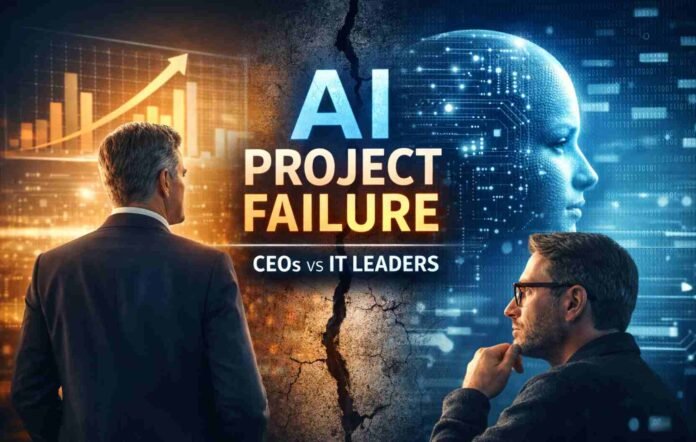
- AI projects fail when CEOs and IT leaders are not aligned on goals and realities
- Talking about outcomes beats talking about transformation
- Start small with pilots, track KPIs, then scale what works
- Culture and upskilling determine whether AI sticks or stalls
Artificial intelligence is the hottest topic in boardrooms right now. It is pitched as the next big leap in productivity, customer experience, and competitive advantage. For many CEOs, AI feels like a once-in-a-generation opportunity to modernize how work gets done and how decisions are made.
But inside the same companies, the people tasked with making AI real often see something else entirely.
IT leaders are not short on enthusiasm. They are simply closer to the operational truth. They know what it takes to integrate new systems, protect data, manage risk, and scale tools without breaking what already works.
That difference in perspective is not a minor disagreement. It is the simple reason so many AI initiatives fail to move beyond slides, pilots, and big promises.
The problem is not the technology. It is the advice gap.
In many organizations, especially mid market firms, CEOs and IT leaders are taking their cues from different worlds.
One side hears about transformation and disruption. The other hears about infrastructure limits, governance, and security exposure. When those realities do not meet in the middle, AI becomes aspirational instead of actionable.
The modern IT landscape has changed the rules
The role of IT is no longer tucked away in a technical corner. Technology is now central to almost every function, from finance to customer support to marketing operations. Everyone has opinions because everyone touches tools every day. That familiarity has raised expectations and reduced patience for slow systems, long rollouts, or cautious decision making.
Mid market businesses feel this most. Teams are leaner. Roles overlap. Leaders often wear multiple hats. Many CEOs have hands on experience with systems and platforms. Some even understand basic development concepts. Meanwhile, IT leaders are not just technicians anymore. They are operational partners, risk managers, and internal consultants.
That overlap can be powerful, but it can also create tension. When both sides feel informed, but rely on different sources of advice, decisions get muddy. Ownership becomes unclear. Timelines become unrealistic. AI becomes a debate instead of a delivery plan.
The result is predictable. Projects stall, trust erodes, and the business quietly moves on to the next trend.
Building a shared language that actually works
If there is one fix that changes everything, it is this. Stop talking about AI like a magic upgrade and start talking about outcomes.
Words like transformation, innovation, and future proofing are inspiring, but they are too vague to guide execution. AI only becomes useful when leaders agree on what success looks like in plain business terms.
That could mean reducing response times in customer service. Improving forecasting accuracy. Cutting manual admin work in finance. Increasing conversion rates through smarter personalization. Or accelerating internal reporting so leaders can make decisions faster.
Once AI is framed around measurable goals, the conversation changes. CEOs can still pursue ambition, but ambition is grounded in delivery. IT leaders can raise constraints without sounding like blockers, because the constraints are tied directly to what the business wants to achieve.
Transparency matters here. Companies need honest conversations about data quality, integration readiness, cybersecurity requirements, and workforce capability. The point is not to dampen momentum. The point is to prevent avoidable disappointment.
A practical roadmap beats a perfect strategy
A winning AI approach is not a massive multi year program with unclear milestones. It is a phased plan that proves value early and scales with confidence.
Start with high impact use cases that are realistic. Choose projects where data is accessible, workflows are stable, and the benefit is obvious. Run pilots with tight scope. Measure results with clear KPIs. Review outcomes quickly. Then scale what works.
This is where cross functional collaboration becomes essential. AI should not live inside IT alone. Finance, operations, marketing, sales, and customer teams all need to be involved early. When those teams help shape the pilot, you uncover practical issues sooner and avoid building something that looks impressive but does not fit the business.
Small cross disciplinary teams also reduce duplication. They prevent competing experiments across departments and they help standardize tools, governance, and best practice before things sprawl.
Culture is the hidden multiplier
Even the best roadmap fails without the right culture. AI adoption is not just a systems project. It is a people shift.
Boards and leadership teams need to make experimentation safe. Teams should feel encouraged to test ideas, learn fast, and improve rather than fear being blamed for early failures. The organizations that win with AI are not the ones that never fail. They are the ones who learn faster than everyone else.
Upskilling also matters. Non-technical teams need enough understanding to use AI responsibly and effectively. Technical teams need the space to think beyond infrastructure and focus on business impact. When both sides share the same baseline knowledge, friction drops and progress speeds up.
Turning alignment into measurable impact
The CEO and IT divide is real, but it is fixable. The businesses that close the advice gap will move faster, spend smarter, and see results sooner.
AI does not fail because it is overhyped. It fails because leadership teams do not align early on goals, constraints, and ownership. When boards speak the same language, AI becomes a practical lever, not a buzzword. And for mid-market firms, that alignment can be a serious advantage, because agility is already built into how they operate.
The future belongs to the companies that stop arguing about AI and start executing with clarity.
Follow TechBSB For More Updates