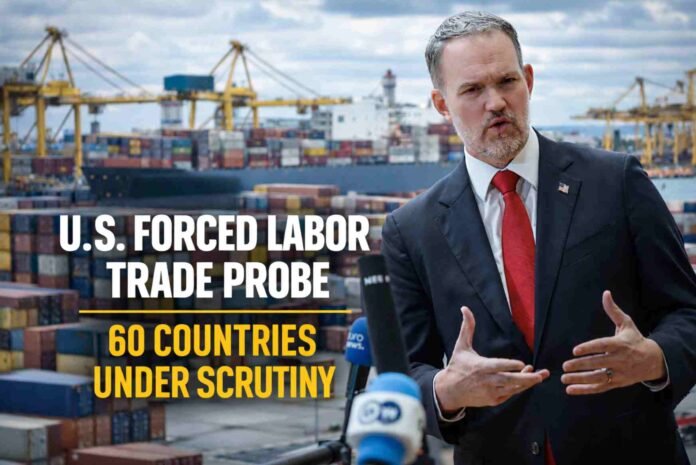
- The United States launched Section 301 investigations into 60 economies over concerns about forced labor in global supply chains.
- Countries under review include major allies and partners such as India, the EU, Canada, and Australia.
- The probe follows a US Supreme Court ruling that struck down President Trump’s global tariffs.
- Findings may lead to new trade penalties or tariffs before temporary tariffs expire in July.
The United States has opened a wide-ranging investigation into alleged forced labor practices linked to global trade, placing 60 countries under scrutiny. The inquiry, launched by the Office of the US Trade Representative, will examine whether governments have done enough to prevent goods made with forced labor from entering international supply chains and ultimately the American market.
Officials say the investigation will determine if the failure to curb such practices harms US workers and businesses. The probe is being conducted under Section 301 of the Trade Act of 1974, a legal tool the United States has historically used to respond to what it considers unfair trade policies.
US Trade Representative Jamieson Greer said the investigation aims to assess whether foreign governments are enforcing meaningful restrictions on imports produced through forced labor. According to Greer, these practices remain unacceptable and undermine fair global trade standards.
The move marks one of the most expansive trade reviews in recent years and reflects the Trump administration’s renewed push to reshape global trade rules following a recent legal setback on tariffs.
Major economies and allies included in the investigation
The investigation is not limited to geopolitical rivals. The list of 60 economies includes several close US allies and major trading partners such as Australia, Canada, the European Union, the United Kingdom, Israel, India, Qatar and Saudi Arabia. China and Russia are also among the countries named in the probe.
The inclusion of such a wide group suggests that Washington intends to examine global supply chains rather than focus solely on traditional competitors. It also signals a broader strategy to pressure governments worldwide to adopt stricter labor enforcement policies.
Taiwan, which also appears on the list, responded quickly to the announcement. Its government stated that it remains committed to strengthening labor protections and preventing forced labor. Officials added that Taiwan is willing to work with the United States to reinforce human rights, improve supply chain resilience and support sustainable governance.
For many countries involved in global manufacturing networks, the investigation could mean greater scrutiny of labor standards and sourcing practices. Governments may also face pressure to align their trade policies with US expectations regarding forced labor enforcement.
Investigation follows tariff setback and renewed trade pressure
The investigation comes shortly after the US Supreme Court struck down a sweeping global tariff plan introduced by President Donald Trump earlier this year. The court ruled on February 20 that the broad tariff measure exceeded the legal authority granted under existing trade law.
In response, the Trump administration moved quickly to restore some level of tariff pressure through other legal mechanisms. One step included imposing a temporary 10 percent tariff for 150 days using Section 122 of the Trade Act of 1974.
At the same time, Washington has launched additional trade investigations targeting excess industrial capacity in 16 major trading partners. Officials argue that overproduction in key sectors can distort global markets and disadvantage American industries.
Together, these actions indicate a broader effort by the administration to reassert economic leverage through trade enforcement tools, particularly after the court’s decision limited its ability to apply sweeping tariffs.
Forced labor concerns remain central to US trade policy
Forced labor has increasingly become a major focus of US trade policy over the past several years. One of the most prominent examples is the Uyghur Forced Labor Prevention Act, which was signed into law during the Biden administration.
That legislation blocks goods linked to forced labor from China’s Xinjiang region from entering the United States unless companies can prove their supply chains are free from such practices.
The US government has accused Chinese authorities of operating labor camps that involve ethnic Uyghurs and other Muslim minorities. Beijing has consistently rejected these allegations, stating that its policies in Xinjiang are designed to combat extremism and promote economic development.
Despite the disagreement, Washington continues to emphasize forced labor as a central issue in trade negotiations and enforcement actions. Greer noted that the United States wants other countries to implement import bans similar to provisions found in longstanding American trade laws that prohibit goods produced with forced labor.
The current investigations are expected to conclude before the temporary tariffs imposed earlier this year expire in July. Depending on the findings, the United States could introduce new trade measures, including tariffs or other penalties, against countries that fail to meet its labor enforcement expectations.
The outcome of the probe could also reshape international supply chains, especially for industries where labor standards remain under scrutiny.
Follow TechBSB For More Updates