
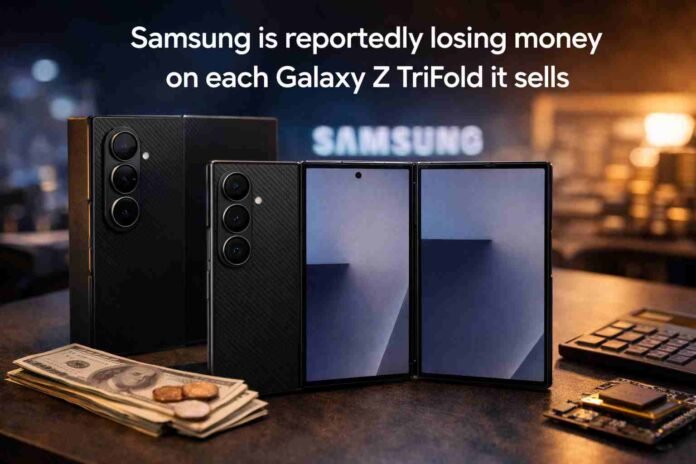
- Samsung is reportedly losing money on every Galaxy Z TriFold sold
- High component costs and low production volumes drive the losses
- The phone is positioned as a special edition, not a mass market product
- Samsung is prioritizing long term foldable innovation over short term profit
Samsung is no stranger to expensive experiments, but the Galaxy Z TriFold may be its boldest and riskiest move yet. Priced at roughly 2,500 dollars in South Korea, the device sits far above anything else in the company’s smartphone lineup.
Yet despite the eye watering price tag, Samsung is reportedly losing money on every single unit it sells.
That detail explains a lot. It explains why the phone is available only in limited markets. It explains the careful language executives are using when discussing sales expectations.
And it explains why the TriFold feels less like a mass market product and more like a public prototype meant to signal where Samsung wants mobile hardware to go next.
This is not a phone designed to dominate sales charts. It is a statement.
Selling at a Loss Is a Strategy, Not a Mistake
According to reports from South Korea, Samsung is fully aware that the Galaxy Z TriFold is not profitable.
The company is not even attempting to squeeze a margin out of the device at this stage. Instead, it is deliberately absorbing losses to get the product into the hands of early adopters and to refine its next generation of foldable technology.
At the TriFold launch event, a senior Samsung executive described the phone as a special edition product rather than a mainstream release. The message was clear. This device exists so that people who want to experience it can do so, not because Samsung expects to sell it in high volume.
Several factors are pushing costs higher than usual. Advanced foldable displays are still expensive to manufacture. The complex hinge system required for a triple fold design adds another layer of cost and engineering risk.
On top of that, a global memory shortage driven largely by demand from artificial intelligence hardware has pushed up prices for key components like RAM and storage.
Samsung reportedly chose to reduce memory pricing internally to hit what it already considers a difficult retail price. Even then, the math does not work in its favor.
Why a 2,500 Dollar Phone Still Is Not Enough
For most consumers, 2,500 dollars for a smartphone already feels excessive. Yet the TriFold’s price does not reflect what the device would cost if Samsung were aiming for profit from day one.
The reality is that early generation hardware almost always carries hidden costs. Yields are lower. Defect rates are higher. Manufacturing processes are slower and less efficient. When a device is built in relatively small numbers, economies of scale simply do not exist.
There is also the cost of learning. Every TriFold sold provides Samsung with real world data on durability, usage patterns, and long term reliability. That information is invaluable, and it cannot be replicated in a lab.
This approach has precedent. Game consoles have historically launched at a loss, with manufacturers betting that component prices will fall over time and that profits can be made later through software and services.
Samsung appears to be applying a similar philosophy to foldables, even though smartphones do not benefit from recurring software sales in quite the same way.
What This Means for the Future of Foldables
For now, the Galaxy Z TriFold remains a niche device aimed at enthusiasts, collectors, and developers rather than everyday users. Its limited availability and extreme price ensure that it will not disrupt the broader smartphone market in the short term.
However, its existence signals something important. Samsung is willing to spend heavily to stay ahead in foldable design, even if that means taking losses today.
The company clearly believes that multi fold devices will eventually move from novelty to necessity, especially as productivity and multitasking become more central to mobile computing.
When the TriFold eventually reaches markets like the United States in early 2026, it will almost certainly remain expensive. But if history is any guide, future versions will be cheaper, thinner, and easier to manufacture. The losses Samsung is absorbing now are effectively an investment in that future.
For consumers, the takeaway is simple. You are not paying for luxury alone. You are paying for experimentation, ambition, and a glimpse of where smartphones might be headed next.
Follow TechBSB For More Updates