
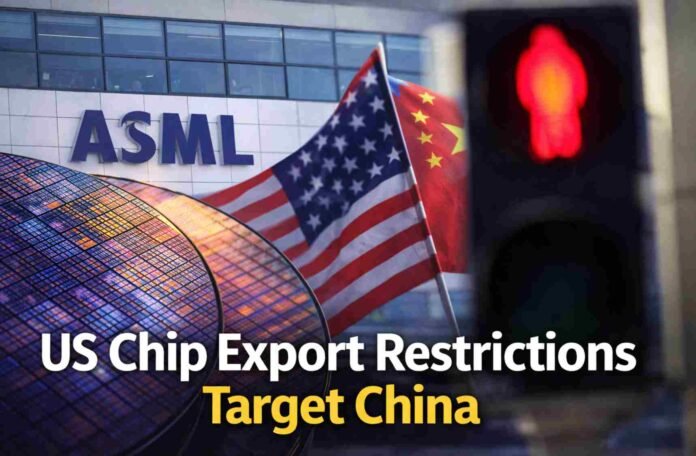
- US lawmakers propose stricter rules to block chip equipment exports to China.
- The bill targets both sales and servicing of critical semiconductor tools.
- Companies like ASML could face major business impacts due to reduced China access.
- The move aims to protect US leadership in AI and advanced chip technology.
The United States is once again sharpening its stance on semiconductor exports to China, but this time the initiative is coming directly from Congress. A bipartisan group of lawmakers has introduced a draft bill that could significantly widen existing restrictions on the sale and servicing of chipmaking equipment.
The goal is clear: limit China’s ability to produce advanced semiconductors and protect the US lead in artificial intelligence and next generation computing.
Unlike earlier measures driven by presidential administrations, this proposed legislation signals a more permanent and unified political effort. It also aims to bring allied nations into closer alignment, ensuring that companies outside the US follow similar rules rather than filling gaps left by American restrictions.
Why ASML and Others Are in Focus
At the center of this proposal is the highly specialized world of chip manufacturing tools. Companies such as ASML have become critical players because they produce lithography machines essential for building modern semiconductors. These machines are incredibly complex and difficult to replicate, making them a strategic chokepoint in the global supply chain.
While previous export controls already blocked the most advanced equipment from reaching China, companies have continued to sell older but still capable systems. These tools, particularly immersion DUV lithography machines, remain vital for producing a wide range of chips used in consumer electronics, automotive systems, and industrial applications.
The proposed law seeks to close that gap. It would not only prevent new sales of such equipment to China but also restrict maintenance and servicing. This is significant because ongoing support is essential to keep these machines operational. Cutting off service could gradually degrade the effectiveness of existing equipment already installed in Chinese facilities.
Targeting China’s Semiconductor Backbone
The legislation specifically names several of China’s leading chipmakers as targets. These include major players involved in everything from memory production to advanced logic chips. By restricting their access to both equipment and support, US lawmakers hope to slow the country’s progress in developing a self sufficient semiconductor ecosystem.
This approach reflects a broader strategy that focuses on areas where China remains dependent on foreign technology. Despite heavy investment and rapid progress, China still relies on imported tools for key manufacturing processes. By tightening controls on these dependencies, the US aims to maintain its technological edge.
At the same time, the bill emphasizes coordination with allied countries. This is crucial because many of the world’s top semiconductor equipment firms are based outside the US. Without international cooperation, restrictions could be undermined by alternative suppliers.
Economic Stakes and Industry Impact
The proposed restrictions come with significant economic implications, particularly for companies heavily exposed to the Chinese market. For instance, China has been a major source of revenue for equipment makers, accounting for a substantial portion of their sales in recent years.
However, that reliance is already shifting. Companies have begun preparing for tighter controls, and some expect their exposure to China to decrease over time. Still, a complete halt on certain sales and services would accelerate that transition and potentially impact global supply chains.
For the broader tech industry, the move adds another layer of complexity to an already fragmented landscape. Manufacturers may need to rethink production strategies, diversify supply chains, and navigate an increasingly politicized environment.
A Longer Term Tech Rivalry
This latest proposal underscores how deeply the semiconductor industry is intertwined with geopolitics. Chips are no longer just components; they are strategic assets that influence economic power, national security, and technological leadership.
If passed, the legislation would mark another step in an ongoing effort to reshape the global semiconductor ecosystem. It signals that restrictions are not a temporary measure but part of a sustained strategy to manage competition with China over the long term.
Follow TechBSB For More Updates