
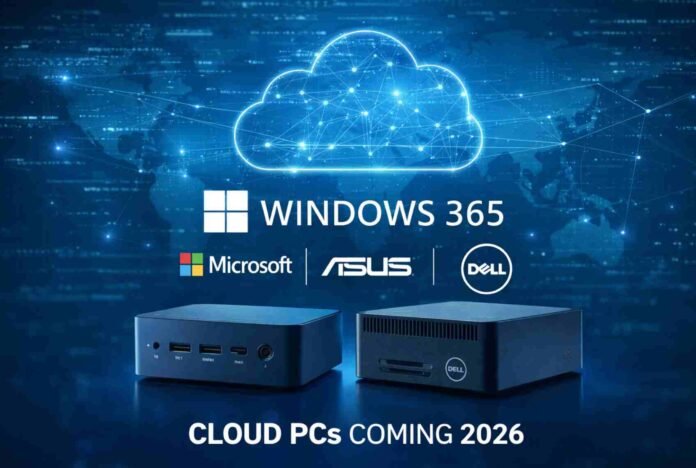
- Microsoft confirmed Asus and Dell will launch Windows 365 Cloud PCs in Q3 2026.
- The devices boot directly into Windows 365 and store no local data or apps.
- Asus is targeting modern hot desking setups with its compact NUC 16 based device.
- Dell is focusing on regulated sectors with a fanless, security centric desktop.
Microsoft is doubling down on its cloud desktop strategy. The company has confirmed that both Asus and Dell are developing dedicated Windows 365 Cloud PC devices, with general availability expected in Q3 2026.
The announcement came from Stefan Kinnestrand, Vice President of Windows Commercial Marketing, who revealed that the two new systems will boot directly into Windows 365. Unlike traditional desktops, these machines are purpose built for cloud computing. They do not store apps, files, or workloads locally. Instead, everything runs from Microsoft’s cloud infrastructure.
That shift is the entire point. These are not standard PCs with cloud features bolted on. They are designed from the ground up to function as secure access terminals for a fully hosted Windows environment.
The move signals Microsoft’s intent to broaden Windows 365 beyond its existing first party hardware, positioning it as a serious alternative to conventional enterprise desktops.
Asus Targets Modern Workspaces With Compact Power
Asus will bring a Windows 365 version of its NUC 16 platform to market. The device occupies just 0.7 liters of space, making it compact enough to mount behind a monitor. That form factor makes it especially appealing for hot desking environments, shared offices, and space constrained setups.
Under the hood, Asus says the system will feature the latest Intel processor, along with DDR5 memory, WiFi 6E, Bluetooth 5.3, and 2.5GbE LAN. Connectivity includes USB A, USB C, and HDMI, and it supports up to three displays.
While the standard NUC 16 Pro configuration can scale to high end specifications such as Intel Core Ultra X9 processors, Arc B390 graphics, up to 128GB of memory, WiFi 7, Bluetooth 6.0, and dual M.2 SSDs, the Windows 365 Cloud PC version will be tuned differently. Since workloads live in the cloud, local performance demands are reduced. What matters most is stable connectivity and secure access.
Asus appears to be positioning its device as a flexible endpoint for modern businesses embracing hybrid work. In environments where employees move between desks or locations, a cloud native PC eliminates concerns around local data storage and device management.
Dell Focuses on Regulated Industries
Dell’s entry into the Windows 365 Cloud PC lineup takes a slightly different approach. Its Pro Desktop model will use Intel N series processors and adopt a compact, fanless design.
The lack of a fan is not just about noise reduction. It also improves durability and reliability in controlled environments. Dell is clearly targeting sectors such as healthcare, finance, and public services, where regulatory compliance and data security are critical.
Like the Asus system, Dell’s Cloud PC will support up to three displays. However, its positioning is more specialized. For organizations that need strict endpoint security and minimal local exposure, a diskless, cloud booting desktop offers an additional layer of reassurance.
In highly regulated industries, the idea that no sensitive information resides on the physical machine is a powerful selling point.
A Broader Push for Cloud Native Computing
These two OEM devices will join Microsoft’s existing Windows 365 Link hardware, which is already available in 20 countries. By expanding the hardware ecosystem, Microsoft is making it easier for businesses to standardize around a cloud first desktop model.
The core concept behind Windows 365 Cloud PC is straightforward. The desktop experience lives in the cloud. Users log in and access their full Windows environment from virtually anywhere. IT teams gain centralized management and simplified security. Hardware becomes an access point rather than a storage device.
Pricing details have not yet been disclosed, but both Asus and Dell are targeting Q3 2026 for release.
If Microsoft succeeds, the line between local PC and cloud service could blur even further. Instead of upgrading hardware to handle heavier workloads, companies may increasingly rely on scalable cloud infrastructure. The physical device becomes smaller, quieter, and simpler.
For enterprises navigating hybrid work, compliance pressures, and growing cybersecurity concerns, that proposition could be hard to ignore.
Follow TechBSB For More Updates