
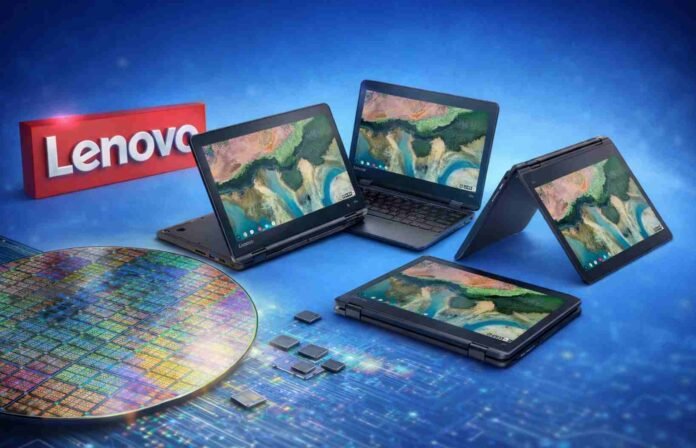
- Lenovo warns PC unit sales may face pressure due to tightening memory supply.
- Quarterly revenue rose 18 percent, but reported profit fell due to restructuring costs.
- RAM shortages are linked to growing AI infrastructure demand.
- AI server revenue is growing rapidly as Lenovo pivots toward inference workloads.
Lenovo has posted impressive quarterly numbers, but beneath the strong revenue growth lies a more complicated story. The world’s largest PC maker is now openly acknowledging that global chip shortages, particularly in memory, are starting to bite.
Chief executive Yang Yuanqing confirmed that memory constraints are putting pressure on hardware shipments. While demand for PCs remains healthy, the company expects unit sales to face strain as component availability tightens.
To soften the blow, Lenovo has already raised prices to offset climbing memory costs. Yang noted that although volumes may come under pressure, the company believes it can continue growing revenue and protect profitability.
This shift in tone reflects a broader industry reality. The semiconductor market is being reshaped by surging demand from artificial intelligence systems, leaving traditional hardware segments competing for supply.
Strong revenue growth masks operational pressure
On paper, Lenovo’s latest quarterly performance looks solid. Revenue rose 18 percent year over year to 22.2 billion dollars, beating expectations. Adjusted net profit climbed 36 percent to 589 million dollars, demonstrating strong operational momentum.
However, reported net profit declined 21 percent to 546 million dollars. The drop was largely attributed to a 285 million dollar restructuring charge linked to internal changes. Lenovo says the restructuring should deliver up to 200 million dollars in savings over the next three years, positioning the company for leaner operations ahead.
The company’s core business, spanning PCs, tablets, and smartphones, remains its financial backbone. This division accounts for roughly 70 percent of total revenue and recorded a 14.3 percent sales increase during the quarter. That growth came despite mounting supply chain friction.
Still, executives were candid about the strain caused by RAM shortages. Rising component costs and limited availability are complicating planning cycles and shipment schedules. The tension between robust customer demand and restricted supply is becoming increasingly difficult to ignore.
AI demand reshapes the semiconductor landscape
A key factor behind tightening memory supply is the rapid expansion of artificial intelligence infrastructure. Chipmakers are increasingly prioritizing AI workloads, particularly for large scale data centers and advanced computing systems.
Lenovo is not standing still in this transition. Its digital infrastructure group posted 31 percent revenue growth, reflecting strong demand for servers and enterprise systems. However, the unit recorded an operating loss of 11 million dollars, driven by continued heavy investment in AI capabilities.
The company reported high double digit growth in its AI server business, fueled by deployments of advanced rack scale systems built around Nvidia’s latest platform designs. According to Yang, demand is gradually shifting from large language model training toward inference workloads. This transition is prompting Lenovo to refine its server portfolio to better align with enterprise use cases.
Lenovo expects the AI infrastructure market to triple by 2028. In response, it recently unveiled new enterprise servers optimized for inference tasks, developed in collaboration with major chip partners. The strategy is clear. While PC shipments may slow, AI infrastructure represents a high growth opportunity that could offset pressure elsewhere.
Balancing price hikes and market uncertainty
The central question is whether Lenovo can successfully balance higher pricing, supply limitations, and strategic investment without losing momentum. Raising PC prices may protect margins in the short term, but sustained increases could dampen consumer and enterprise demand if economic conditions soften.
At the same time, investing aggressively in AI infrastructure is not without risk. Scaling advanced server systems requires capital, specialized components, and close coordination with semiconductor suppliers. Any further tightening in memory supply could complicate those plans.
What makes Lenovo’s warning notable is its position at the top of the global PC market. If the industry leader anticipates shipment pressure, smaller players are likely feeling similar or greater strain.
The memory crunch underscores how interconnected today’s technology ecosystem has become. Growth in one segment, such as AI, can rapidly reshape supply dynamics across the entire hardware market.
For now, Lenovo remains confident in its ability to navigate the turbulence. Revenue is rising, demand remains strong, and the company is repositioning itself for an AI driven future. Yet the coming quarters will test whether higher prices and strategic pivots can fully counterbalance the reality of constrained supply.
Follow TechBSB For More Updates