
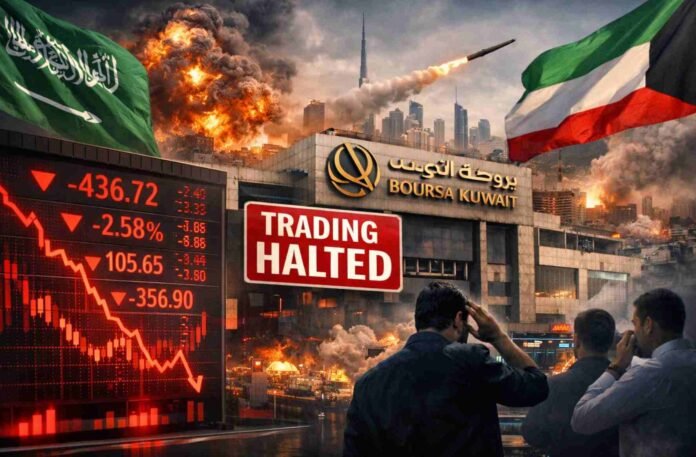
- Gulf stock markets plunged after US Israeli strikes on Iran triggered retaliatory attacks.
- Boursa Kuwait suspended trading due to exceptional circumstances.
- Saudi Arabia’s index fell sharply, while Aramco rose on oil price expectations.
- Explosions in Gulf cities and airport shutdowns deepened fears of regional conflict.
Investors across the Gulf woke up to one of the most volatile trading sessions in recent memory as escalating tensions between the United States, Israel and Iran triggered a sharp market selloff.
What began as coordinated US Israeli strikes on Iranian targets quickly spiralled into retaliatory missile and drone attacks across key Gulf locations, rattling financial markets and forcing an unprecedented move from Kuwait’s stock exchange.
In a rare and dramatic decision, Boursa Kuwait suspended all trading activity, citing exceptional circumstances. The halt underscores the gravity of the unfolding crisis and reflects mounting concerns over regional stability, capital flight and investor panic.
Across the Gulf Cooperation Council region, traders rushed to price in geopolitical risk, pushing major indices sharply lower before some pared losses later in the day. The sudden downturn highlights how sensitive Middle Eastern markets remain to military escalation, particularly when oil infrastructure and major urban centres are involved.
Saudi Arabia Leads Regional Selloff as Investors Seek Safety
Saudi Arabia, home to the region’s largest stock exchange, saw its benchmark index tumble as much as 4.6 percent in early trade before narrowing losses to around 2 percent.
Banking stocks bore the brunt of the pressure, with Al Rajhi Bank falling 2.8 percent and Saudi National Bank sliding 4.3 percent. Budget carrier flynas dropped 5.8 percent as concerns mounted over airspace disruptions and reduced travel demand.
Interestingly, not every stock moved in the same direction. Energy giant Saudi Aramco climbed 2.6 percent as traders anticipated that escalating conflict could push global oil prices higher. Oil markets often respond swiftly to geopolitical shocks in the Gulf, and investors appear to be positioning for potential supply disruptions.
Elsewhere, Oman’s Muscat index dropped more than 3 percent before trimming losses to 1.8 percent. Heavyweight OQ Base Industries declined 1.3 percent.
Bahrain’s main index slipped 0.9 percent, while Qatar’s market remained closed for a bank holiday. Outside the Gulf, Egypt’s blue chip index plunged 5.5 percent in early trade, with widespread losses across its constituents.
The broad based selloff suggests that investors are not viewing this as an isolated flare up but rather as a potential turning point that could reshape the region’s economic outlook.
Explosions Reported as Retaliation Intensifies
Market anxiety was fuelled by reports of fresh explosions across the Gulf. Witness accounts described blasts in Dubai and over Doha for a second consecutive day. Additional explosions were reported in Manama, adding to fears that key commercial hubs are no longer insulated from direct confrontation.
Iran’s retaliation followed US Israeli strikes that reportedly killed Iranian Supreme Leader Ayatollah Ali Khamenei. The escalation marked a dramatic shift in the conflict’s intensity and triggered missile and drone attacks targeting strategic and symbolic locations in the United Arab Emirates.
Among the sites reportedly hit were Jebel Ali Port, Burj Al Arab, Palm Jumeirah and Dubai International Airport. Major regional airports, including Dubai, suspended operations, creating one of the largest disruptions to global aviation in recent years. The aviation sector now faces cascading delays, cancelled routes and rising insurance costs.
The combination of military strikes, airport shutdowns and damage to critical infrastructure has amplified concerns that the conflict could extend beyond a short lived exchange.
Investors Brace for Prolonged Instability
Financial markets in the Middle East are often seen as an early barometer of how investors interpret geopolitical shocks. The current downturn reflects fears that tensions could escalate into a prolonged regional confrontation involving multiple states.
Oil remains the central variable. While higher crude prices could support energy exporters in the short term, sustained instability risks undermining foreign investment, tourism, aviation and banking activity. Sovereign wealth funds and institutional investors are also likely to reassess exposure as the situation develops.
Currency markets and safe haven assets such as gold are expected to see increased volatility in the coming days. For now, caution dominates trading floors across the region.
Boursa Kuwait’s suspension sends a clear signal that authorities are prioritising stability over liquidity. Whether other exchanges follow suit will depend on how quickly tensions ease or intensify.
The coming days will be critical. If diplomatic channels reopen and hostilities subside, markets may stabilise. If not, the Gulf could face its most severe economic shock in years.
Follow TechBSB For More Updates