
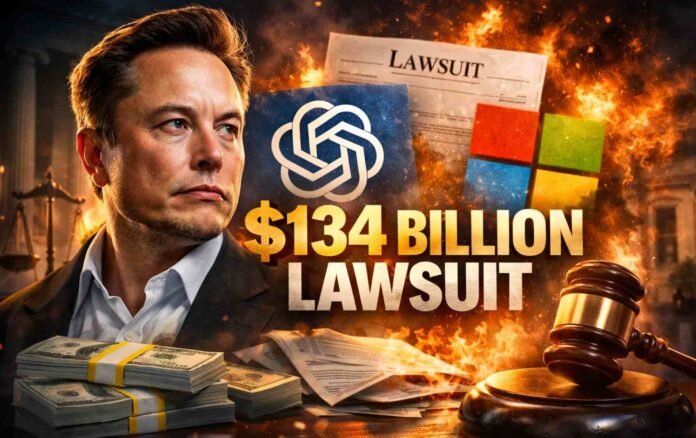
- Elon Musk is seeking $79 billion to $134 billion from OpenAI and Microsoft in damages.
- The claim is based on an expert valuation tied to Musk’s $38 million early backing and alleged contributions.
- The damages estimate includes $65.5 billion to $109.4 billion for OpenAI and $13.3 billion to $25.1 billion for Microsoft.
- With Musk worth around $700 billion, the lawsuit appears to be about influence and accountability as much as money.
Elon Musk is escalating his legal fight with OpenAI and Microsoft with a damages claim that lands somewhere between staggering and surreal. According to a new expert analysis cited by Bloomberg, Musk is seeking between $79 billion and $134 billion in compensation, arguing that OpenAI abandoned the nonprofit mission it originally championed and that he was effectively misled as a co founder and early backer.
The number does not come from a casual estimate or courtroom theatrics alone. It is tied to a formal damages assessment prepared by C. Paul Wazzan, a financial economist known for high stakes valuation work in complex commercial disputes.
His background reads like a career built for moments like this, with extensive deposition experience and multiple trial appearances, all centered on the math and logic of who gained what and who lost what when a business relationship goes sideways.
At the heart of Musk’s argument is a familiar Silicon Valley storyline. Early supporters take the biggest risks, contribute money and credibility when a project is fragile, and expect that if it becomes a global powerhouse, the upside is enormous.
In this case, the claim is that Musk’s early support was foundational and that OpenAI’s later transformation into a massively valuable commercial entity changed the deal in ways that should trigger serious financial consequences.
How the damages figure was calculated
Wazzan’s analysis reportedly starts with Musk’s $38 million seed contribution, dating back to OpenAI’s earliest days in 2015. From there, it expands beyond cash alone, factoring in Musk’s technical influence, business input, and the strategic weight his name carried in attracting talent, partners, and attention at a time when OpenAI was still defining what it wanted to be.
The resulting calculation frames the damages as a share of OpenAI’s current valuation of roughly $500 billion, which would imply an eye popping return if treated like an early investment stake. That is the part that will make many readers pause.
A seed contribution that turns into tens of billions suggests a return on the scale of venture capital folklore, except here it is being argued inside a courtroom.
The analysis also splits the alleged gains between OpenAI and Microsoft. It estimates wrongful gains of $65.5 billion to $109.4 billion for OpenAI, and $13.3 billion to $25.1 billion for Microsoft. Microsoft’s involvement matters because it is deeply tied to OpenAI’s commercialization and is said to hold a 27 percent stake in the company.
Musk’s legal team is essentially positioning him as the kind of early startup participant who should benefit when the rocket ship takes off, especially if the claim is that the company’s mission was shifted in a way that undermined the original premise.
Why this isn’t really about the money
On paper, the lawsuit is about damages. In practice, the numbers make it hard to believe money is the core motivation.
Musk’s wealth is now estimated at around $700 billion, placing him far ahead of everyone else in the global billionaire rankings.
Reports have pointed out that his net worth has grown so large that it exceeds the world’s second richest person by an extraordinary margin. Put bluntly, even the top end of the damages request would not reshape Musk’s life. It would simply add another towering layer to an already historic fortune.
That context changes how the lawsuit reads. It starts to look less like a typical dispute over returns and more like a high intensity power struggle over control, influence, and narrative. For OpenAI, the damages demand reinforces the idea that Musk’s actions are part of a broader campaign rather than a narrow legal grievance.
The company has reportedly warned partners and investors that Musk may pursue attention grabbing claims as the case heads toward trial.
And that trial is not far off. The dispute is scheduled to be heard in April in Oakland, California, putting one of the tech industry’s most personal and politically charged conflicts on a very public timeline.
What to watch as the trial approaches
This case has all the ingredients of a modern tech showdown. A famous founder figure. A mission driven origin story. A company that went from idealistic nonprofit language to world changing commercial power. A mega partner in Microsoft. And a damages number so huge it forces everyone to ask what the real goal is.
Even if the numbers are reduced or challenged, the lawsuit may still shape how OpenAI is perceived, how it structures itself going forward, and how future AI organizations think about governance and mission promises.
Follow TechBSB For More Updates