
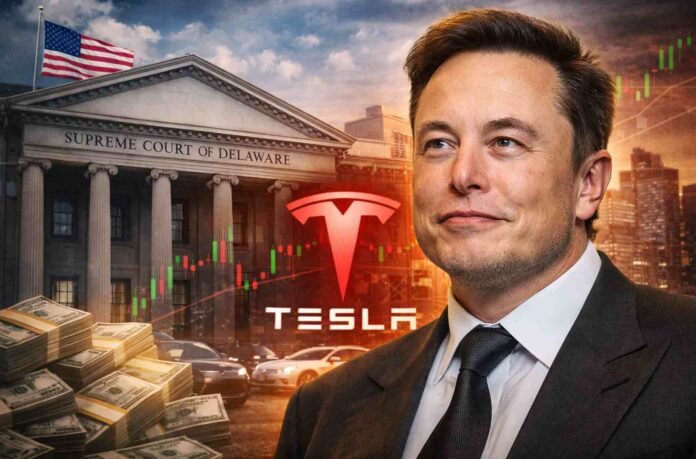
- Delaware’s top court reinstated Elon Musk’s 2018 Tesla compensation plan.
- The ruling overturns a prior Chancery Court decision that canceled the award.
- The package could now be worth about one hundred forty billion dollars.
- The decision likely ends years of litigation and reshapes executive pay debates
In a ruling that reshapes one of the most closely watched corporate governance fights in recent memory, the Delaware Supreme Court has restored Elon Musk’s landmark 2018 compensation package from Tesla, a deal originally valued at fifty six billion dollars and now worth far more due to the company’s soaring share price.
The unanimous decision overturns a prior ruling by Delaware’s Chancery Court, which had invalidated the award after concluding it was improperly negotiated and insufficiently disclosed to shareholders.
In its opinion, the Supreme Court found that stripping the package left Musk effectively unpaid for six years of work during a period when Tesla transformed from a struggling automaker into one of the world’s most valuable companies.
Adjusted for Tesla’s recent stock highs, analysts cited by Bloomberg estimate the reinstated award could now approach one hundred forty billion dollars. That staggering figure alone ensures the ruling will reverberate far beyond Musk or Tesla.
Why the Court Changed Its Mind
At the heart of the dispute was whether Tesla’s board had fulfilled its duties when crafting Musk’s 2018 pay plan. The Chancery Court previously sided with a shareholder who argued the process was flawed and that Musk’s influence over the board undermined meaningful independence.
The Supreme Court took a different view. It emphasized the extraordinary nature of the compensation structure, which paid Musk nothing unless Tesla achieved a series of aggressive operational and market capitalization targets.
According to the court, Musk met every one of those milestones. To void the agreement after the fact, the justices wrote, amounted to penalizing performance rather than protecting shareholders.
The opinion also stressed that Tesla’s shareholders had twice endorsed the package, first in 2018 and again in a 2024 vote that reaffirmed the deal after the Chancery Court initially struck it down. While the lower court discounted the second vote, the Supreme Court treated it as evidence of informed shareholder support.
Fallout for Tesla and Corporate America
The decision likely ends a legal saga that has shaped Tesla’s corporate strategy in unexpected ways. Frustrated by Delaware’s courts, Musk pushed to reincorporate Tesla in Texas, a move that has since inspired other companies to reconsider where they base their legal homes.
With the 2018 award restored, Tesla is expected to unwind a separate twenty nine billion dollar compensation plan it offered Musk earlier in 2025. That package had been designed as insurance in case the appeal failed.
A much larger compensation plan approved in November remains intact and continues to set new performance hurdles for Musk in the years ahead.
The ruling also sends a broader signal to boards and investors. Performance based pay, even at unprecedented scale, will receive judicial deference when shareholders knowingly approve it and executives deliver results.
For critics of excessive executive compensation, the decision is a sobering reminder of how difficult it can be to unwind deals once they are ratified.
A Case That Refused to Stay Small
What made this case especially striking was its origin. The lawsuit was filed by Richard Tornetta, a shareholder who owned just nine shares of Tesla stock. Musk and his supporters repeatedly highlighted that fact, arguing that a single small investor should not be able to undo a deal backed by millions of other shareholders.
Still, the case forced rare courtroom testimony from Musk and years of litigation that consumed enormous corporate resources. When news of the ruling broke, Musk responded on X with a single word: Vindicated.
Whether one views the outcome as a triumph of entrepreneurial reward or a cautionary tale about concentrated power, the Supreme Court’s ruling closes a chapter that has influenced boardrooms across the country. It also cements Musk’s compensation plan as a defining symbol of the modern era of executive pay.
Follow TechBSB For More Updates