
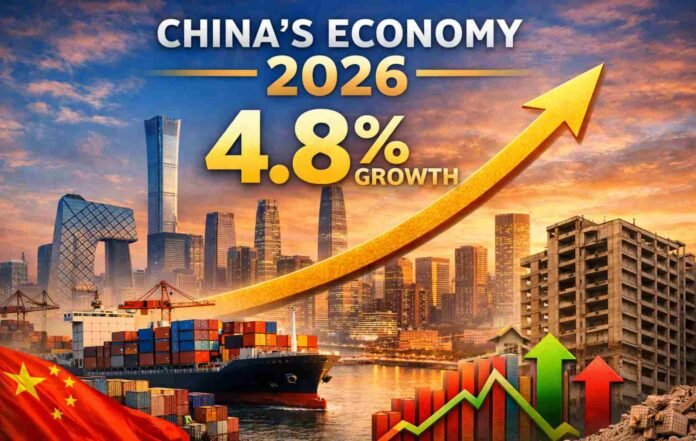
- China’s economy is expected to grow 4.8 percent in 2026, beating consensus forecasts
- Exports remain strong as firms expand into emerging markets
- Weak jobs and low consumption continue to weigh on domestic demand
- The property downturn persists but its drag on growth is slowly easing
China’s economy is expected to grow at a steadier pace in 2026 than many economists had anticipated, supported primarily by resilient exports and a gradual easing of the drag from the property sector. New projections point to real GDP growth of 4.8 percent, slightly below last year’s performance but still comfortably ahead of the broader consensus forecast.
This outlook reflects how China’s growth model continues to evolve after years of trade tensions, pandemic disruptions, and a prolonged housing downturn. While traditional engines such as real estate remain weak, external demand and policy support are helping stabilize overall momentum.
Exports and Policy Support Drive the Outlook
Exports remain the standout pillar of China’s economic performance. Despite higher tariffs from the United States in recent years, Chinese exporters have adapted by expanding aggressively into emerging markets. This diversification has helped sustain strong export volumes, with real export growth estimated to have reached around 8 percent in 2025.
Falling export prices have also enhanced competitiveness, allowing Chinese manufacturers to gain market share even as global demand remains uneven. Looking ahead, export price inflation is expected to turn modestly positive in 2026 as producer price deflation eases and the yuan strengthens slightly against the dollar.
Policy support adds another layer of resilience. Monetary and fiscal easing are expected to be somewhat stronger than markets currently assume, with government borrowing set to increase. Authorities are aiming to cushion economic weaknesses without resorting to large scale stimulus, favoring targeted measures instead.
Inflation dynamics remain subdued. Producer prices are still in deflation, though the pace is slowing, and consumer inflation is likely to stay below 1 percent for most of the year. Temporary factors such as higher gold prices and trade in subsidies may offer brief boosts, but underlying price pressures remain soft.
Consumption and Jobs Remain the Weak Spots
While exports are holding up well, domestic demand continues to face structural challenges. Household consumption has been constrained by a weak labor market and declining property values, both of which have weighed on confidence and income growth.
Employment indicators suggest hiring conditions are among the weakest seen in the past decade outside of pandemic lockdowns. Wage growth in urban areas has slowed noticeably, limiting households’ ability and willingness to spend. These pressures are not easily resolved, as high tech manufacturing is capital intensive and new technologies are reducing demand for certain types of labor.
In response, policymakers are expected to introduce targeted employment and income support measures. These may include subsidies for service industries, adjustments to minimum wages, reduced social security contributions for lower income and flexible workers, and expanded unemployment benefits. While helpful, these steps are unlikely to fully offset deeper structural and cyclical headwinds.
Government consumption, however, is projected to accelerate, partially compensating for slower household spending. As a result, overall consumption is expected to make a roughly neutral contribution to GDP growth in 2026.
Property Sector Still a Drag but Losing Force
China’s property market remains the economy’s most persistent source of weakness. Now in its fifth year of decline, activity indicators such as new home starts, sales, and investment remain far below their peaks from earlier in the decade.
Inventory levels are high, financing conditions for developers are tight, and there is little evidence of an imminent turnaround.
Historical comparisons with housing downturns in other countries suggest further price declines may still lie ahead, with nationwide real prices unlikely to stabilize before 2027. That said, the economic damage caused by the property sector appears to be diminishing gradually.
While real estate has subtracted roughly two percentage points from annual GDP growth in recent years, that drag is expected to narrow incrementally going forward. Fewer new construction projects continue to weigh on activity, but the worst phase of the contraction may be passing.
A Changing Growth Model with Uneven Progress
China’s economic trajectory in 2026 highlights a broader transition underway. Export strength and policy easing are providing stability, but rebalancing toward a consumption and services-driven economy remains a long term challenge rather than a near term solution.
The result is an economy that can still deliver respectable growth, but one that relies heavily on external demand and government support while grappling with deep structural adjustments at home.
Follow TechBSB For More Updates