
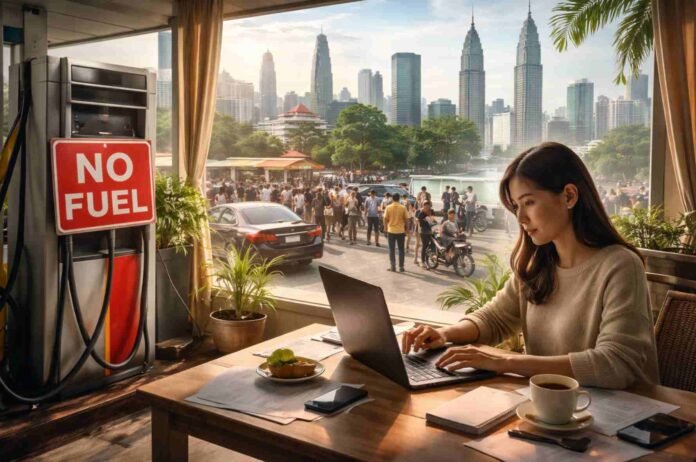
- Asian governments are introducing work from home policies to reduce fuel consumption.
- Pakistan ordered half of public sector workers to shift to remote work immediately.
- Vietnam, Thailand, and the Philippines introduced energy saving workplace measures.
- Fuel shortages could also affect data centers and digital infrastructure if the crisis continues.
A new wave of remote work policies is taking shape across parts of Asia, but this time the trigger is not a pandemic. Governments are turning to work from home strategies as disruptions in global oil supplies begin to affect fuel availability across the region.
Recent military actions involving the United States and Israel in Iran have unsettled energy markets, creating shortages that several Asian countries are now trying to manage. In response, governments are introducing measures designed to reduce fuel consumption, limit unnecessary travel, and maintain essential services through digital infrastructure.
The approach echoes strategies used during the COVID 19 pandemic, when large segments of the workforce moved online almost overnight. Now, many administrations are once again relying on remote work systems and collaboration tools to keep operations running while conserving scarce energy resources.
Pakistan and Southeast Asia adopt emergency energy measures
Pakistan has taken one of the most decisive steps so far. Prime Minister Shehbaz Sharif directed that half of all public sector employees immediately shift to working from home. The move aims to reduce transportation fuel consumption while keeping government services operational.
Authorities are also encouraging private sector organizations to adopt similar measures. Universities and higher education institutions have been asked to move classes online wherever possible. Officials say the shift could significantly cut commuting related fuel usage across major cities.
Elsewhere in Southeast Asia, governments are introducing their own variations of energy saving policies.
Vietnam’s Ministry of Industry and Trade has urged both businesses and citizens to work remotely whenever possible. At the same time, officials are encouraging people to rely more on bicycles instead of motorized transport as part of broader efforts to reduce fuel demand.
Thailand has adopted a similar stance within the public sector. Government workers who are not directly involved in frontline services have been instructed to work from home. In addition to remote work policies, authorities are also pushing energy saving guidelines inside offices that remain open.
For example, air conditioning systems are recommended to operate at temperatures no lower than 26 degrees Celsius. Workers are also encouraged to take stairs instead of elevators where practical, another small step intended to reduce electricity consumption during the current energy strain.
Philippines experiments with hybrid work to limit travel
The Philippines has introduced a more flexible system rather than a full remote mandate. Government agencies have been asked to implement a four day in office schedule, leaving room for remote work days or compressed workweeks.
Under this approach, departments can designate specific work from home days for employees or arrange schedules that reduce commuting and office energy usage.
Authorities are also promoting virtual meetings instead of in person gatherings to limit transportation demand across government operations.
This hybrid structure allows public institutions to continue face to face work where necessary while still lowering overall fuel consumption.
Energy uncertainty raises concerns for digital infrastructure
While remote work reduces commuting and fuel use, it also places heavier reliance on digital infrastructure.
Data centers across Asia are designed with backup power systems, typically powered by diesel generators, to maintain operations during electricity disruptions. However, many facilities only store a limited supply of fuel, often enough for a few days of continuous operation.
If energy shortages worsen, maintaining uninterrupted digital services could become more challenging. Remote work depends heavily on cloud platforms, productivity software, and video conferencing systems that require stable data center operations.
Despite these concerns, the region’s experience with pandemic era remote work has provided governments with a working blueprint. Many public institutions already use online collaboration tools, cloud based systems, and digital communication platforms.
Officials believe these capabilities will allow administrations to continue operating even if fuel shortages persist in the short term.
Crisis driven remote work may shape future policies
The current shift highlights how geopolitical conflicts can ripple far beyond their immediate regions. Energy disruptions are forcing governments to rethink how workplaces function, even thousands of miles away from the conflict itself.
Remote work policies that were once considered temporary pandemic measures are now being redeployed as energy management tools.
If shortages continue or global fuel markets remain unstable, these strategies could evolve into longer term workplace models across parts of Asia.
For now, governments are focusing on balancing two priorities. They must maintain public services while also managing energy resources carefully during a period of global uncertainty.
The situation also underscores how modern economies increasingly depend on reliable digital infrastructure to sustain everyday operations when traditional systems are disrupted.
Follow TechBSB For More Updates