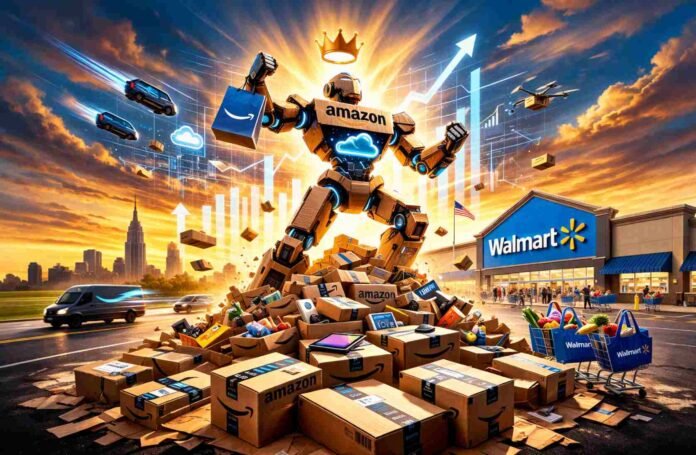
- Amazon has surpassed Walmart in annual revenue to claim the top Fortune 500 position.
- AWS profitability fueled Amazon’s expansion and funded aggressive innovation.
- Walmart transformed itself into a serious ecommerce contender under new leadership.
- Both companies now compete across retail, cloud, AI, and logistics ecosystems.
For years, the top spot on the Fortune 500 list felt permanent. Walmart occupied it with the quiet confidence of a retail empire that had already outlasted generations of rivals.
Now the balance has shifted. Amazon has edged ahead in annual revenue, marking a symbolic and strategic changing of the guard in corporate America.
This was not a sudden surge. It was a long campaign built on reinvention. When Jeff Bezos told investors in 1998 that he wanted to build the world’s most customer centric company, it sounded aspirational.
In hindsight, it reads like a blueprint. Bezos borrowed the philosophy from retail legend Sam Walton, who famously insisted that the customer is the only real boss. Both companies internalized that lesson. Only one kept stretching it into new frontiers.
Amazon’s rise from a modest online bookstore in the mid 1990s to the largest revenue generator in America is astonishing on paper. In 2010, Walmart’s revenue dwarfed Amazon’s by more than twelve times. Fifteen years later, the gap has closed and then reversed. What changed was not just scale but scope.
Reinvention as strategy, not slogan
Amazon did not overtake a retailer with decades of head start by perfecting online shopping alone. It expanded the definition of what it is. Prime membership turned casual buyers into loyal subscribers. Entertainment offerings made the ecosystem sticky. Logistics investments slashed delivery times and raised expectations across the industry.
The pivotal move, however, was the creation of Amazon Web Services. What began as an internal infrastructure project became a global cloud powerhouse. Under the leadership of Andy Jassy, AWS matured into a profit engine that now generates the majority of Amazon’s operating income. Retail brings in enormous revenue. Cloud computing delivers the margin.
That financial cushion gives Amazon freedom. It can experiment aggressively, absorb high profile failures, and fund entirely new categories. The Fire Phone flopped. Physical retail concepts stumbled.
Healthcare initiatives were launched and shuttered. Yet each misstep reinforced a culture that tolerates risk. In Silicon Valley terms, failing fast is not embarrassment. It is iteration.
Now Amazon is pushing heavily into artificial intelligence infrastructure. Massive capital expenditure plans reflect an understanding that the next platform shift will be defined by data centers, chips, robotics, and automation. For a company of Amazon’s size, standing still would be riskier than spending boldly.
Walmart’s comeback story
The narrative would be incomplete without Walmart’s response. For years, the Arkansas giant underestimated ecommerce. Its early online experiments in the 1990s lacked urgency. Physical stores were seen as an unassailable moat. That assumption weakened as online shopping surged.
The appointment of Doug McMillon signaled a reset. A company lifer who understood both stores and systems, McMillon pushed Walmart to embrace digital retail in earnest. Acquisitions such as Jet.com accelerated learning. Store networks were reimagined as fulfillment hubs rather than liabilities.
The strategy paid off. Walmart is now the second largest ecommerce player in the United States, with digital growth rates that rival many pure online competitors. Its strength in grocery, particularly curbside pickup, remains a critical advantage. Even Amazon’s purchase of Whole Foods Market has not fully closed that gap.
At the same time, Walmart has sharpened its physical retail experience and captured market share from competitors such as Target and Kroger. In other words, it did not simply copy Amazon. It adapted selectively while leaning into its strengths.
Two rivals, increasingly alike
The irony is striking. Amazon began as a tech company disrupting retail. Walmart was the ultimate brick and mortar operator. Today, both are hybrid giants blending physical stores, ecommerce, logistics, advertising, and data driven services.
Amazon resembles a modern conglomerate, competing not just with Walmart and Costco but also with hyperscalers such as Google, Microsoft, and Meta in cloud and AI infrastructure. Walmart, meanwhile, operates a sophisticated digital ecosystem that would have been unrecognizable to its leadership two decades ago.
Joining past Fortune 500 leaders such as Exxon Mobil and General Motors, Amazon’s ascent reflects broader economic shifts. Energy and manufacturing once dominated revenue rankings. Now data, logistics, and cloud platforms lead the pack.
Yet the contest is far from over. Amazon’s North American retail growth is slowing compared to its earlier breakneck pace. Walmart’s ecommerce expansion is accelerating. Both companies are investing heavily in automation and AI to protect margins in a competitive environment.
If there is a lesson here, it is not that one giant defeated another. It is that scale alone is never enough. Reinvention remains the ultimate competitive advantage.
Follow TechBSB For More Updates