
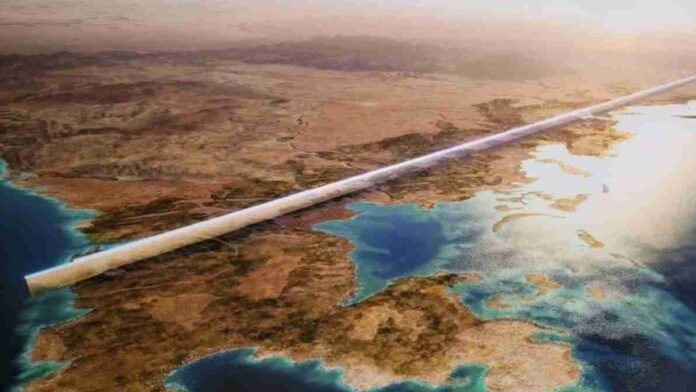
- The Line is reportedly being reconsidered due to delays and rising costs
- Residential ambitions may be replaced by AI focused data center development
- Coastal access enables potential seawater cooling for high density servers
- Financial pressure is forcing Saudi megaprojects to scale back or phase plans
For years, The Line has stood as one of the boldest urban concepts of the modern era. A 170 kilometer mirrored city slicing through the desert. Nine million residents living in a hyper dense, car free environment. ‘Autonomous transport, renewable energy and a complete rethink of how cities work. It was a vision designed to signal ambition on a global scale.
Now that vision appears to be under serious review.
According to multiple reports, Saudi Arabia is reassessing the scope of The Line after internal evaluations highlighted delays, mounting construction costs and growing fiscal pressure.
Instead of a city built to house millions, planners are said to be considering a dramatically smaller role for the site, one centered on industrial use and advanced computing rather than residential life.
While officials have stopped short of confirming a full pivot, the direction of travel is becoming clearer. The Line, at least in the near term, may no longer be about people. It may be about machines.
From futuristic city to AI infrastructure hub
The revised thinking reportedly focuses on transforming sections of The Line into a large scale data center complex. Rather than apartments, schools and public services, the emphasis would shift to high density server halls designed for cloud computing, AI training and inference workloads.
This change reflects a broader national push. Saudi Arabia has been pouring resources into artificial intelligence, including the purchase of thousands of high end GPUs for state backed initiatives.
Large domestic data centers would give the country greater control over compute capacity while supporting ambitions to become a regional AI powerhouse.
Under this model, efficiency would take priority over spectacle. Operators are expected to favor bare metal infrastructure and tightly packed server deployments to maximize performance per square meter.
The mirrored walls and residential layers that once defined The Line’s identity could become secondary or disappear entirely from early phases.
In effect, what was once pitched as a revolutionary urban experiment risks becoming a more conventional, if still massive, piece of digital infrastructure.
Climate, cooling and the Red Sea advantage
Running data centers at scale in Saudi Arabia is not without challenges. Extreme heat and scarce freshwater make cooling both expensive and inefficient. Independent studies have already flagged much of the country as poorly suited for traditional data center operations.
This is where The Line’s location offers a rare advantage. Its proximity to the Red Sea opens the door to seawater based cooling systems, which could significantly reduce reliance on freshwater and improve thermal efficiency.
Planners are said to be exploring this option as a way to offset the environmental and operational costs of running energy hungry AI facilities in a desert climate.
Even so, cooling is only part of the equation. Power availability remains a critical concern.
Similar AI focused data center projects elsewhere have faced scrutiny after satellite imagery and grid analysis raised questions about whether sufficient electricity could be delivered to support full scale operations. Whether The Line can overcome these constraints at the proposed scale remains uncertain.
Financial pressure reshapes national priorities
The rethink around The Line cannot be separated from Saudi Arabia’s wider financial picture. Years of heavy public spending are colliding with tighter liquidity, lower oil revenues and a crowded slate of national commitments. Major events such as the Expo trade fair and the 2034 World Cup are demanding resources and attention.
In this context, pausing or downsizing an ultra ambitious residential megacity begins to look less like a failure and more like a pragmatic recalibration. Officials have emphasized phased development and alignment with national priorities rather than rigid adherence to original timelines or designs.
This language leaves room for flexibility. The Line may still exist in some form, but not necessarily as the population dense urban spine once promised. Observers note that other Saudi megaprojects have already undergone similar quiet adjustments, with scaled back scopes and extended timelines.
For now, the silence around a full reaffirmation of the original plan is telling. The linear city model, once central to Neom’s identity, may no longer be the immediate focus. Instead, Saudi Arabia appears to be placing its bets on AI infrastructure as a faster, more controllable path to global relevance.
Four point summary