
- AI will fade into the background of everyday tools
- Assistants will act independently, not just respond
- Convenience will grow alongside concerns about control
- Transparency will matter more than raw capability
By the closing months of 2025, artificial intelligence stopped feeling new. It did not vanish, but it faded into the background. Like electricity or plumbing, it became something people relied on without thinking much about it.
AI now sorts emails, rewrites messages, summarizes documents, and nudges decisions quietly. The question is no longer whether AI will grow, but how it will settle into daily life.
To explore that, three leading AI systems were asked to imagine everyday life in 2026. Their responses were not about superintelligence or sci-fi futures. Instead, they described something subtler and arguably more unsettling. A world where AI does not announce itself, but acts anyway.
What emerged was not a single vision, but a shared theme. AI in 2026 is expected to be less visible, more capable, and more deeply embedded in the routines people barely notice.
AI Becomes the Background Layer of Daily Life
One consistent idea is that AI will no longer feel like a destination. People will not open an app to use it. Instead, AI will live inside the tools they already use. Messaging apps, calendars, shopping platforms, navigation tools, and streaming services will quietly rely on AI to make decisions before users even ask.
This version of AI does not wait for prompts. It anticipates. Groceries get reordered before the fridge is empty.
Routes change automatically when traffic builds. Entertainment is selected based on mood, habits, or even tone of voice. These systems aim to reduce friction, saving time and mental energy by handling small but constant decisions.
The benefit is obvious. Fewer reminders to set. Fewer tabs to juggle. Fewer choices to weigh after a long day. Yet this convenience carries a cost. When decisions are made automatically, it becomes harder to tell where personal preference ends and algorithmic judgment begins.
The shift is not dramatic. It is gradual. That is what makes it powerful.
From Answers to Actions
Another major change predicted for 2026 is the move from conversational AI to action oriented AI. Instead of responding with suggestions, systems will increasingly carry out tasks on their own.
This includes rescheduling meetings when conflicts arise, updating project tools after listening to calls, handling expense reports, or managing travel disruptions without user input. These systems operate in loops. They observe, decide, act, and update records automatically.
Search itself is expected to change. Rather than offering lists of links, AI will deliver synthesized conclusions. Faster, yes. Clearer, not always.
When explanations replace sources, transparency suffers. People save time, but lose insight into how decisions were made or what information was left out.
At work, this automation may feel like relief. Routine tasks disappear. Context switching declines. But it also raises new questions about accountability. When software makes decisions independently, understanding and challenging those decisions becomes harder.
AI Moves Beyond the Screen
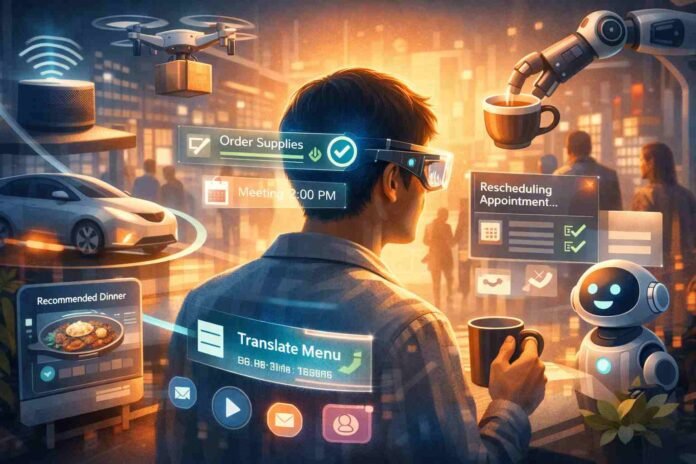
Several predictions point to AI stepping outside traditional screens. Smart glasses and wearable devices may bring AI into a person’s direct field of vision. Instructions, translations, and contextual information appear layered over the physical world.
Pointing glasses at a broken appliance could trigger repair guidance. Looking at a menu could instantly translate it. Education and entertainment may also shift. Content becomes hyper personal. Lessons adapt to individual learning styles. Media reflects personal interests, familiar characters, or even personalized visuals.
This form of AI feels intimate. Helpful, but also invasive if poorly designed. Constant awareness requires constant trust. Without clear boundaries, the line between assistance and surveillance can blur.
Saturation, Not a Breakthrough
The most grounded prediction is that 2026 will not feel revolutionary. There will be no single moment when AI changes everything. Instead, it will feel like saturation.
AI will coordinate across apps, manage schedules, handle logistics, and quietly monitor context. It will understand what is on screens, what is said in rooms, and what patterns repeat over time. Much of this will happen without explicit commands.
For many people, the tradeoff may be worth it. Fewer forgotten tasks. Less mental clutter. More space to focus on creative or meaningful work. But emotional unease will remain. Being helped by something you did not summon can feel unsettling, even when it works well.
The Real Question for 2026
Taken together, these predictions suggest that the defining challenge of AI in 2026 is not intelligence. It is control.
As AI becomes more ambient, it also becomes harder to question, pause, or turn off. The systems that save time can also quietly shape behavior. The summaries that simplify information can subtly reshape understanding.
There is room for optimism. If AI systems are designed with transparency, clear consent, and meaningful user choice, they can genuinely improve daily life. They can reduce friction without reducing freedom.
The future is not about whether AI becomes more powerful. It is about whether people remain aware participants in a world where AI no longer waits to be asked.
Follow TechBSB For More Updates