
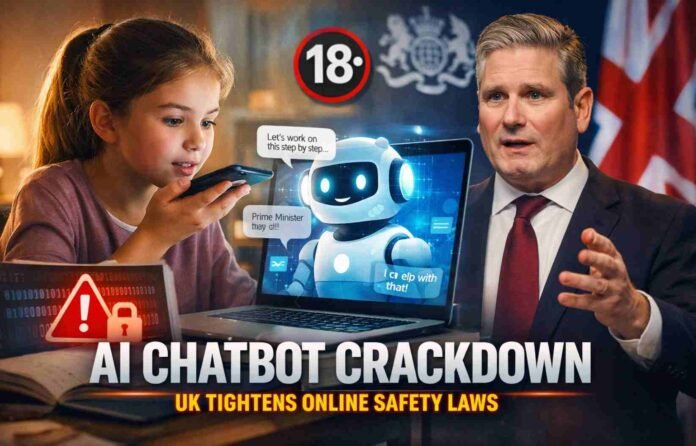
- The UK will include AI chatbots under the Online Safety Act’s illegal content rules.
- Firms could face fines or blocking if they fail to prevent unlawful material.
- New measures may set age limits and restrict harmful platform features.
- The move signals a shift toward regulating AI system design, not just user content.
The UK government is tightening the net around artificial intelligence chatbots, bringing them firmly under the scope of the Online Safety Act in a move designed to protect children better.
Prime Minister Keir Starmer confirmed that the same illegal content obligations as social media platforms will now bind AI firms operating chatbot services.
The decision follows mounting pressure over sexually explicit material allegedly generated by chatbot systems, including reports that content involving minors had surfaced on X’s Grok tool.
The controversy triggered regulatory scrutiny and sharpened political focus on what ministers describe as a dangerous regulatory gap.
Starmer’s message was unequivocal. No platform gets special treatment. If a service allows illegal content to circulate or fails to prevent it, it could face fines or even be blocked in the UK.
Until now, the Online Safety Act primarily focused on user generated content hosted on platforms. AI chatbots existed in a gray area. That gap is now closing.
What the new rules mean for AI companies
Under the updated framework, chatbot providers including OpenAI’s ChatGPT, Google’s Gemini and Microsoft’s Copilot will be expected to meet illegal content duties set out in the legislation. That includes preventing the generation or distribution of unlawful material and acting swiftly when breaches occur.
The shift reflects a broader recognition that AI systems are not passive tools. Their design, training and deployment shape how content is produced and shared. Regulators increasingly see them as active participants in the digital ecosystem rather than neutral intermediaries.
Ofcom, the UK’s communications regulator, had already begun investigating X following allegations that Grok generated explicit images. The government’s latest announcement reinforces that such incidents will not be treated as isolated glitches but as systemic compliance issues.
The new measures go further than chatbot oversight. Starmer outlined plans to set minimum age limits for social media platforms, curb features such as infinite scrolling that are believed to encourage compulsive use, and restrict children’s access to both AI chatbots and VPN services that could bypass safeguards.
Another proposed rule would require social media companies to retain relevant user data after the death of a child unless it is clearly unrelated. The aim is to support investigations and provide clarity for grieving families.
A shift in how technology is regulated
Legal experts say the change signals a philosophical shift in British tech policy. For years, lawmakers preferred to regulate outcomes and use cases rather than specific technologies. That approach was seen as flexible enough to accommodate innovation.
But generative AI has tested those assumptions.
Instead of merely hosting content created by users, chatbots can generate text and images autonomously. That blurs the line between platform and producer. According to industry observers, the government now appears willing to address risks embedded in technological design rather than limiting oversight to user behavior.
The broader European context adds momentum. Australia recently introduced a ban preventing under-16s from accessing social media, forcing platforms such as YouTube, Instagram and TikTok to implement stricter age verification processes.
Spain has enacted similar restrictions, while several other European nations are weighing comparable measures.
In the UK, a public consultation on banning social media for under 16s is already underway. Meanwhile, the House of Lords has voted to amend the Children’s Wellbeing and Schools Bill to include such a ban. The proposal must still pass through the House of Commons before becoming law.
Growing pressure on Big Tech
The political climate surrounding online safety has intensified in recent months. Concerns about mental health, exposure to harmful material and the influence of addictive design features have fueled bipartisan calls for tougher oversight.
For AI developers, the regulatory landscape is becoming more complex. Compliance will likely require stronger moderation systems, improved guardrails within models and greater transparency around how content is generated.
At the same time, companies must balance safety with functionality. Chatbots are increasingly embedded in education, productivity tools and everyday communication. Overcorrection could limit innovation, while under enforcement risks legal and reputational fallout.
The government insists the priority is clear. Protecting children comes first.
Starmer framed the reforms as both corrective and preventative. By closing what he called loopholes, the UK aims to ensure that emerging technologies evolve within defined boundaries rather than forcing regulators to play catch up after harm occurs.
Whether other countries follow the UK’s lead in explicitly naming AI chatbots within online safety law remains to be seen. What is clear is that generative AI is no longer operating in a regulatory blind spot.
Follow TechBSB For More Updates