
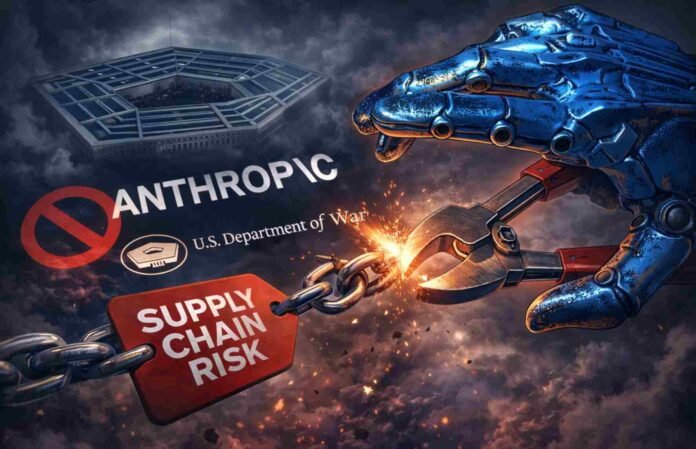
- The Pentagon has labeled Anthropic a supply chain risk, blocking its AI from U.S. military contracts.
- The decision stems from disagreements over safeguards limiting AI use in weapons and surveillance.
- Anthropic plans to challenge the designation in court.
- Companies can still use Claude for projects unrelated to Pentagon work.
The U.S. Department of Defense has formally classified artificial intelligence company Anthropic as a supply chain risk, a move that immediately prevents government contractors from using its AI technology in Pentagon related work.
The decision marks a sharp and unusual confrontation between Washington and one of the country’s most prominent AI firms. Until recently, Anthropic had positioned itself as a key partner for national security agencies seeking advanced artificial intelligence tools.
The designation specifically targets the use of Anthropic’s AI systems, including its Claude models, within Pentagon contracts. Companies that work with the U.S. military must now remove Anthropic powered tools from those projects.
Despite the restriction, Anthropic technology is not banned across the board. Contractors and businesses are still free to use Claude for projects that have no connection to Pentagon work.
The label took effect immediately and has already triggered adjustments among companies involved in defense technology programs.
Dispute over AI safeguards sparks the conflict
At the heart of the conflict is a growing disagreement between Anthropic and defense officials over how artificial intelligence should be used in military environments.
Anthropic has taken a cautious stance on certain applications of its AI systems. The company has repeatedly stated that it will not allow its models to power autonomous weapons or be used for mass surveillance inside the United States.
Pentagon officials have pushed back against those limitations. According to sources familiar with the discussions, defense leaders believe the military should retain flexibility in how emerging technologies are deployed as long as they remain within U.S. law.
That tension has been building for months behind closed doors.
Anthropic CEO Dario Amodei said the new supply chain risk designation stems from the company’s refusal to weaken the safeguards built into its AI systems. He emphasized that Anthropic intends to challenge the decision in court.
Amodei also noted that the restriction is narrow in scope. It applies only to customers who directly integrate Claude into work tied to Defense Department contracts.
Military programs already relied on Claude
The Pentagon’s decision comes even as Anthropic’s technology has reportedly been used in national security operations.
Sources say Claude models have supported intelligence analysis and operational planning tasks, including work connected to military activity involving Iran. AI systems like Claude can quickly process large volumes of data, helping analysts identify patterns or summarize complex intelligence reports.
Anthropic tools have also been embedded inside broader defense technology platforms.
One example is Palantir’s Maven Smart Systems, a software platform used by military organizations for intelligence analysis and targeting workflows. The system reportedly incorporates prompts and processes built using Anthropic’s AI models.
Because of the new designation, defense contractors may now need to replace those AI components if they are used within Pentagon-funded projects.
Companies across the defense technology ecosystem are already reviewing their systems to determine whether Anthropic-powered tools need to be removed.
Industry fallout spreads to partners and investors
The ripple effects are likely to extend well beyond Anthropic itself.
Major technology companies, including Microsoft and Amazon, have invested heavily in the AI firm or integrated its models into their platforms.
Microsoft confirmed that its legal team reviewed the Pentagon’s ruling and concluded that Anthropic technology can still be offered to customers through services such as Microsoft 365, GitHub, and its AI development platforms. The only restriction applies to work tied directly to U.S. military contracts.
Amazon, another major investor and user of Anthropic technology, has not publicly commented on the decision.
The controversy intensified earlier this week after an internal Anthropic memo became public. In that document, Amodei suggested some Pentagon officials were unhappy with the company partly because it had not offered strong public praise for former President Donald Trump.
Amodei later apologized for the memo after it surfaced online, acknowledging that its publication complicated an already sensitive dispute.
Meanwhile, Pentagon technology leadership has indicated that no active negotiations are underway with Anthropic regarding the designation.
For now, the standoff appears headed toward a legal fight that could determine how much influence AI developers have over how their systems are used by the military.
Follow TechBSB For More Updates

