
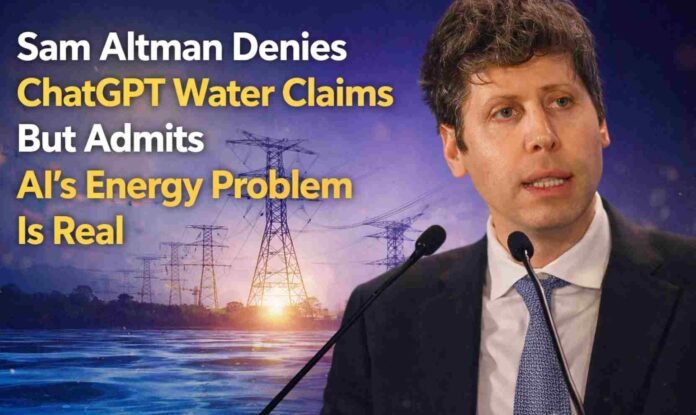
- Sam Altman rejects viral claims that ChatGPT uses extreme amounts of water per query.
- He admits AI energy consumption is a legitimate and growing concern.
- Industry leaders warn AI data center expansion may be financially and environmentally unsustainable.
- The core issue is whether AI can scale globally without straining energy and water resources.
Sam Altman is no stranger to bold statements, but his latest comments may be among his most direct. Speaking at an event hosted by The Indian Express, the OpenAI chief dismissed online claims that ChatGPT consumes extreme amounts of water per query, calling them “totally fake” and disconnected from reality.
Altman was responding to widely shared posts suggesting that each ChatGPT query requires as much as 17 gallons of water.
According to him, those figures are outdated and misleading. He acknowledged that evaporative cooling was once used in certain data centers, a method that does rely heavily on water. However, he said that is no longer the standard approach in OpenAI’s operations.
The internet, as it often does, has run with simplified numbers stripped of context. Altman’s argument is that those numbers no longer reflect how modern AI infrastructure is being cooled or managed. In his view, the viral claims exaggerate a past issue and apply it to a present reality that has already evolved.
That said, dismissing the water argument did not mean dismissing environmental concerns entirely.
Energy demand is the real pressure point
Where Altman did concede ground was on electricity use. He described concerns about AI’s energy appetite as “fair,” noting that global AI adoption is accelerating at a remarkable pace. As more users rely on large models for everything from coding help to content generation, the power required to train and run these systems continues to rise.
AI focused data centers are not ordinary server facilities. They require high density racks, advanced accelerators, and complex cooling systems.
The footprint is larger, the hardware more specialized, and the strain on local grids more intense. In many regions, the rapid build out of AI capacity is already prompting questions about where the energy will come from and who will bear the cost.
Altman suggested that the solution lies in scaling renewable and nuclear energy quickly. Wind, solar, and next generation nuclear, he implied, are necessary if AI is to expand without overwhelming existing power infrastructure.
The economics of that expansion are staggering. Arvind Krishna, CEO of IBM, has publicly questioned whether the current trajectory is financially sustainable.
He estimates that outfitting a single one gigawatt AI facility could cost tens of billions of dollars. Multiply that across dozens of planned sites worldwide, and the potential spending climbs into the trillions.
The message from industry leaders is clear. Efficiency gains in chips and cooling help, but they may not keep pace with the sheer scale of deployment.
The human comparison that raised eyebrows
Altman also offered a more philosophical defense. He argued that conversations about AI energy use often ignore the enormous energy investment required to “train” a human being.
Two decades of food consumption, education, and societal infrastructure are needed before a person becomes highly skilled. From that perspective, he suggested, an AI model answering a question could already be competitive in terms of energy efficiency.
It is an arresting comparison. It reframes the debate from per query electricity usage to lifetime energy investment. But it also risks oversimplifying a complex issue. Human beings are not built solely to answer prompts.
They live, create, form relationships, and contribute in countless ways that go beyond measurable output.
Critics argue that comparing the marginal cost of an AI response to the lifetime cost of a human life misses the point.
The real concern is aggregate demand. Billions of AI queries per day, layered on top of existing digital infrastructure, create a new category of consumption that did not exist at this scale a decade ago.
Scaling responsibly in a resource-constrained world
The broader environmental backdrop makes this debate more urgent. The United Nations has warned that the world is entering an era of severe water stress. Electricity grids in many countries are already stretched thin. Against that backdrop, the explosive growth of AI infrastructure feels less like a technical curiosity and more like a systemic challenge.
Modern accelerators are far more power-hungry than traditional processors. Data center operators are rethinking everything from rack layout to thermal management. In some regions, entire energy projects are being planned with AI demand in mind.
What makes this moment particularly complex is the paradox at its core. AI models are becoming more efficient per operation. Chips are faster. Algorithms are optimized. Yet total consumption continues to rise because usage is growing even faster. Efficiency improvements can be swallowed by scale.
Altman is right to push back on inaccurate numbers. Inflated claims do not help the conversation. But the deeper question remains unresolved. Can AI expand to serve billions of people daily without placing unsustainable pressure on power grids, water systems, and supply chains?
That is not a question that can be dismissed as “totally fake.” It is one that will shape the next decade of technological growth.
Follow TechBSB For More Updates