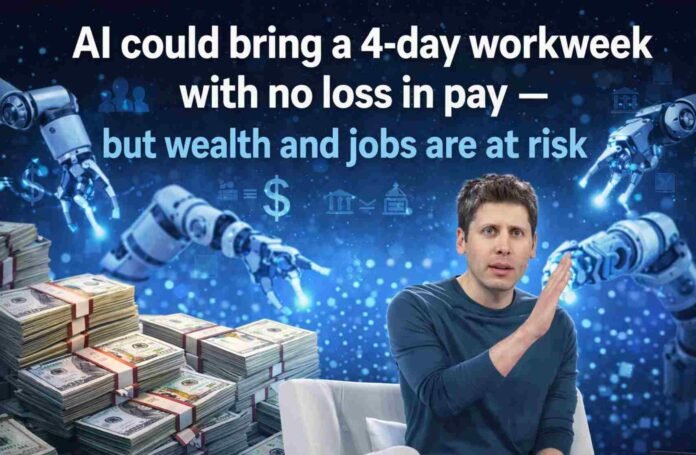
- AI could enable a four-day workweek without cutting pay
- Job disruption is expected, especially in traditional industries
- Wealth may need redistribution through new tax models
- AI is being framed as critical economic infrastructure
For years, the dominant narrative around artificial intelligence has been simple: build fast, scale faster, and avoid anything that might slow progress. Now, that stance appears to be evolving. In a recent policy document, OpenAI puts forward a surprisingly different perspective, one that leans into regulation, shared prosperity, and long-term planning.
The report outlines what it calls an “industrial policy for the intelligence age,” suggesting that governments cannot afford to take a passive role as AI systems grow more capable. Instead, it argues for coordinated action to ensure that the benefits of AI are widely distributed rather than concentrated in a handful of companies or regions.
This marks a notable shift. Rather than resisting oversight, the company is effectively inviting it, framing regulation not as a barrier but as a necessary foundation for stability in an AI-driven world.
The four-day workweek idea gains traction
Among the most attention-grabbing proposals is the idea of a 32-hour workweek with no reduction in pay. The concept is not entirely new, but OpenAI positions it as a realistic outcome of AI-driven productivity gains.
The logic is straightforward. If AI systems can handle more routine and repetitive tasks, businesses could maintain or even increase output while requiring fewer human working hours. In theory, that efficiency could be passed on to employees in the form of shorter workweeks rather than higher workloads or layoffs.
However, the proposal comes with an important caveat. It depends heavily on how companies choose to distribute the gains from automation. Without deliberate policies or incentives, there is no guarantee that increased productivity will translate into better working conditions. Instead, it could simply boost profits.
To address this, the document suggests pilot programs backed by governments, employers, and unions. These trials would test whether productivity can remain stable while reducing working hours. If successful, they could pave the way for broader adoption.
Jobs at risk and new roles emerging
Despite the optimistic tone, the report does not shy away from the risks. Job disruption is identified as the most immediate and visible challenge. Entire sectors could be reshaped or replaced as AI systems take on more complex tasks.
Rather than framing this purely as a loss, the document points to the potential growth of what it calls the “care and connection economy.” This includes roles in healthcare, education, childcare, eldercare, and community services, areas where human interaction remains essential.
The idea is not just to replace lost jobs, but to shift labor toward roles that are inherently human and socially valuable. Still, this transition would require significant investment in training, education, and policy support. Without that, displaced workers could face prolonged uncertainty.
Rethinking wealth, taxation, and ownership
Perhaps the most radical aspect of the proposal lies in how it approaches wealth distribution. If AI reduces reliance on human labor, traditional income tax systems may become less effective. In response, the document suggests shifting the tax burden toward capital and companies that benefit most from automation.
One proposal gaining attention is the creation of a public wealth fund. Under this model, a portion of AI-generated profits would be pooled and redistributed to citizens. It is a concept that echoes sovereign wealth funds, but applied to the digital economy.
This approach aims to prevent extreme concentration of wealth while ensuring that the broader population shares in the benefits of technological progress. It also reflects a deeper shift in thinking about AI, not just as a tool, but as infrastructure that underpins entire economies.
A turning point for AI policy
What stands out most is the broader framing. AI is no longer being discussed solely in terms of products or features. Instead, it is positioned as a foundational force that will shape industries, labor markets, and public institutions.
That shift carries both promise and risk. On one hand, AI could unlock unprecedented productivity and free up time for people to focus on more meaningful work. On the other, it could deepen inequality and concentrate power if left unchecked.
The document ultimately presents a fork in the road. The future of AI will not be determined by technology alone, but by the policies and choices that surround it. Whether governments and institutions can rise to that challenge remains an open question.
Follow TechBSB For More Updates