
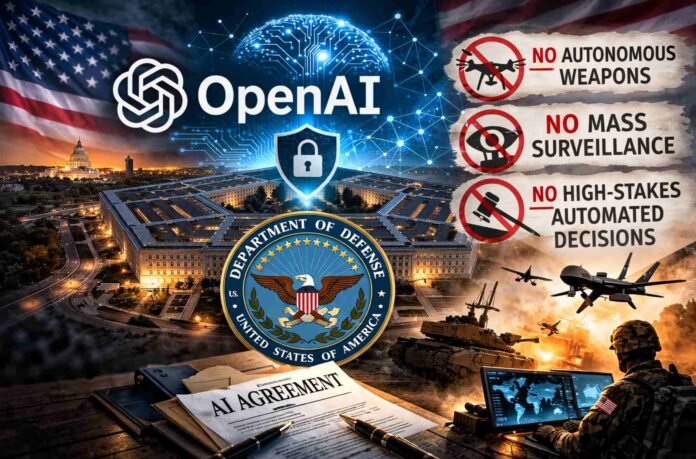
- OpenAI signed a new agreement to deploy AI on classified US defense networks.
- The contract includes three strict red lines, including no autonomous weapons use.
- Safeguards include cloud deployment, human oversight and contractual protections.
- OpenAI opposes labeling rival Anthropic as a supply chain risk.
OpenAI has moved quickly to draw a line between itself and the political storm engulfing its rival, setting out what it calls the most tightly controlled framework yet for deploying artificial intelligence on classified US defense networks.
Just a day after securing a deal with the US Department of Defense, recently renamed the Department of War by President Donald Trump, the company publicly outlined the additional protections baked into the agreement. The message was clear. This is not an open ended military AI partnership. It is a contract built around firm limits.
The announcement followed a dramatic turn in Washington. President Trump directed federal agencies to halt work with Anthropic, while the Pentagon signaled it would label the startup a supply chain risk.
Anthropic has said it will fight any such designation in court. Against that backdrop, OpenAI stepped forward to emphasize both its own safeguards and its opposition to sidelining competitors on security grounds.
Three hard red lines for military AI use
At the center of OpenAI’s defense agreement are three non negotiable boundaries.
First, its technology cannot be used for mass domestic surveillance. Second, it cannot be used to direct autonomous weapons systems. Third, it cannot power high stakes automated decision making.
These are not abstract principles. OpenAI says they are written directly into the contract. The company insists that any use of its models inside classified systems must stay within those clearly defined limits.
The prohibition on autonomous weapons is especially significant. The Pentagon has made no secret of its desire to explore AI across a range of operational domains. At the same time, many AI developers have warned about the dangers of handing lethal decision making to unreliable systems. OpenAI’s stance places it firmly in the camp that draws a bright ethical boundary around such uses.
A layered safety architecture
OpenAI argues that its agreement includes more guardrails than previous classified AI deployments. According to the company, those protections operate at multiple levels.
It retains full control over its internal safety stack, meaning the underlying safeguards embedded in its models remain under its authority. Deployment will take place via cloud infrastructure rather than handing over standalone systems. Cleared OpenAI personnel will remain involved in oversight. The contract itself includes strong enforcement provisions.
Taken together, the company describes this as a multi layered approach. Technology level protections, human oversight and legal constraints all work in tandem. If the US government were to breach the terms, OpenAI says it has the right to terminate the agreement, though it does not expect that scenario to unfold.
The financial stakes are substantial. Over the past year, the Pentagon has signed agreements worth up to 200 million dollars each with major AI labs including OpenAI, Anthropic and Google. The department has signaled that it wants flexibility and does not want to be boxed in by developer imposed warnings about AI reliability.
That tension sits at the heart of the current debate. Defense officials are looking to accelerate adoption. AI companies are trying to ensure their systems are not used in ways that violate their principles or undermine public trust.
A delicate stance on competition and security
While OpenAI moved to highlight its own safeguards, it also made an unexpected point of defending Anthropic. The company said its rival should not be labeled a supply chain risk and that it has made this view clear to the government.
That position is notable in a highly competitive sector where large contracts can shape market dominance. OpenAI is backed by major investors including Microsoft, Amazon and SoftBank. Anthropic has its own powerful supporters. The Pentagon’s decisions could shift the balance of power in the AI arms race.
By publicly opposing a risk designation for Anthropic, OpenAI appears to be signaling that competition should be decided on technical merit and policy alignment rather than political maneuvering.
At the same time, the company is keen to show that its own approach to classified deployments is robust. In an era where AI is increasingly intertwined with national security, perception matters as much as performance.
OpenAI’s strategy seems designed to reassure multiple audiences at once. Lawmakers and civil liberties advocates are told there are hard limits. Defense officials are told there is flexibility within those limits. Investors are shown that major government contracts remain within reach.
The coming months will reveal how durable that balance proves to be. For now, OpenAI is staking its claim as the AI lab willing to work with the military, but only on clearly defined terms.
Follow TechBSB For More Updates

