
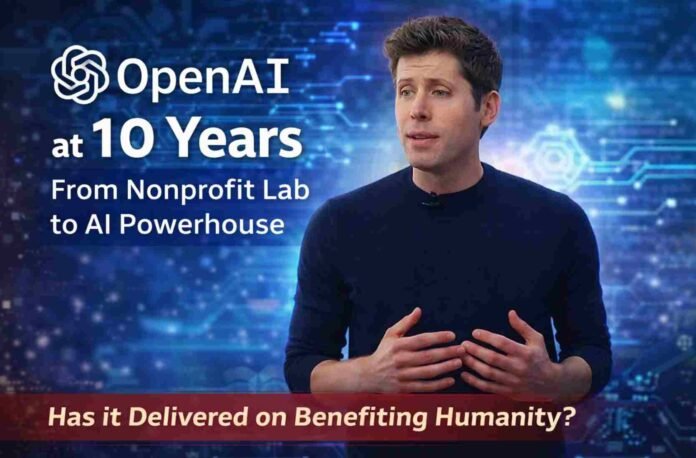
- Founded in 2015 with a mission to build safe and beneficial AGI
- Early breakthroughs like GPT 2 signaled its research strength
- ChatGPT’s 2022 launch ignited the global generative AI boom
- Its impact is undeniable, but debates over safety and equity remain
Ten years ago, OpenAI arrived with little of the spectacle that surrounds it today. There were no product launches streamed to millions, no breathless headlines about trillion dollar valuations.
Instead, there was a mission statement that felt almost academic in tone. The goal was to ensure that artificial general intelligence benefits all of humanity.
Founded in December 2015 by a group that included Elon Musk, Sam Altman, Ilya Sutskever and Greg Brockman, the company began life as a nonprofit research lab. Its early rhetoric focused on safety, collaboration and openness, positioning itself as a counterweight to more secretive corporate AI efforts.
At the time, artificial intelligence was already embedded in search engines, recommendation systems and advertising algorithms.
But the idea of AGI, systems that could outperform humans at most economically valuable work, still felt theoretical. OpenAI’s charter set a high bar. It pledged not just to build powerful systems, but to do so responsibly and to share the benefits broadly.
The question, a decade on, is whether that promise has been honored or quietly reshaped by commercial reality.
The slow burn before the boom
For its first few years, OpenAI was largely a research outfit. Tools such as OpenAI Gym catered to developers experimenting with reinforcement learning. Outside specialist circles, few paid attention.
Early backing proved crucial. In 2016, chip giant Nvidia donated a DGX 1 supercomputer to accelerate OpenAI’s model training. That computing muscle allowed researchers to scale experiments at a time when data and processing power were becoming decisive advantages.
Then came 2019 and the release of GPT-2. Its ability to generate coherent paragraphs from simple prompts felt qualitatively different from earlier chatbots. Silicon Valley took notice. So did policymakers, who began grappling with the implications of systems capable of producing persuasive, humanlike text at scale.
Around this period, OpenAI shifted from a pure nonprofit to a capped profit model, a move that sparked debate about whether idealism was giving way to pragmatism. Yet it also unlocked the capital required to train ever larger models. Ambition at this scale does not come cheap.
ChatGPT and the generative AI shockwave
Everything changed in November 2022 with the public launch of ChatGPT. The interface was simple. The impact was not. Within days, millions were experimenting with prompts. Within weeks, boardrooms were redrawing strategy decks.
Generative AI moved from research papers to dinner table conversation almost overnight. Students used it to draft essays. Developers used it to write code. Businesses explored customer support automation and content creation. The technology industry scrambled to respond.
A major reason OpenAI could scale so quickly was its deep partnership with Microsoft, which integrated OpenAI models into its cloud and productivity products. That alliance catapulted the startup into the center of enterprise computing.
Competitors were forced into rapid reaction. At Google, CEO Sundar Pichai reportedly reorganized teams to accelerate AI efforts. Meanwhile, rivals such as Anthropic gained traction, ensuring the race would be anything but one sided.
ChatGPT did more than create a product category. It reframed AI as a platform shift on par with mobile or cloud computing. In doing so, it cemented OpenAI as a household name.
Has it delivered on benefiting humanity
Assessing whether OpenAI has fulfilled its founding promise depends on perspective.
On one hand, its tools have undeniably democratized access to advanced AI. Small businesses, independent developers and students can now tap into capabilities that once required elite research labs. Productivity gains are real. New companies have been built atop its APIs. Creative experimentation has flourished.
On the other hand, concentration of power remains a concern. Training frontier models requires immense capital and access to cutting edge chips.
Despite its origins as a nonprofit, OpenAI today operates at the heart of a fiercely competitive commercial ecosystem. Tensions with partners and a growing relationship with players such as Oracle signal a company navigating complex strategic terrain.
There are also unresolved questions around misinformation, labor displacement and governance. OpenAI has invested heavily in safety research and alignment work, yet critics argue that deployment often outpaces regulation.
A decade in, perhaps the most honest conclusion is that OpenAI has shifted the conversation. It has accelerated the timeline for AGI discussions from abstract theory to urgent policy debate. Whether that ultimately benefits all of humanity will depend not only on one company’s decisions, but on how governments, competitors and society at large respond.
What is clear is this. OpenAI is no longer a quiet lab with a lofty mission statement. It is a central actor in a technological transformation that is still unfolding.
Follow TechBSB For More Updates