
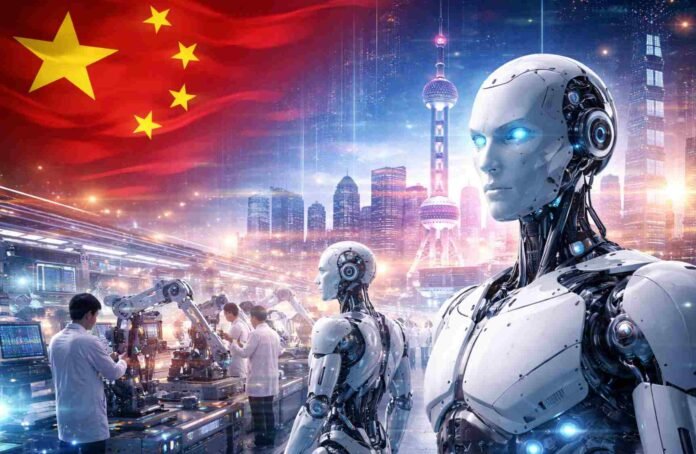
- China’s open source AI models are gaining global traction due to lower costs and flexibility
- Real world deployment across industries is fueling rapid model improvement
- The shift toward embodied AI could give China a long term advantage
- Many Western firms are already adopting Chinese models despite security concerns
China’s growing influence in open source artificial intelligence is raising serious concerns in Washington, with a new advisory report warning that the shift could erode the United States’ long held leadership in AI innovation.
According to the report, Chinese AI firms are building a powerful advantage by embracing open ecosystems and prioritizing widespread deployment. This approach is helping them compete effectively, even while facing restrictions on access to the most advanced semiconductor technologies.
Companies such as Alibaba, Moonshot, and MiniMax are now producing large language models that are not only cheaper to run but also widely adopted across global developer platforms. Their models are increasingly visible in usage rankings, signaling a shift in how developers and businesses are choosing AI tools.
What makes this trend significant is not just performance, but accessibility. By lowering costs and encouraging customization, Chinese models are attracting startups and enterprises that might otherwise rely on Western alternatives.
Open Ecosystems and Data Are Driving China’s Edge
At the heart of China’s strategy is a feedback loop powered by real world deployment. The country is integrating AI across manufacturing, logistics, robotics, and infrastructure at scale. This widespread usage generates vast amounts of data, which in turn improves model performance.
This creates what experts describe as a self reinforcing advantage. The more these systems are used, the smarter they become, and the harder it is for competitors to catch up.
Even with limitations on advanced chips, Chinese developers are finding ways to innovate close to the cutting edge. Open source frameworks allow rapid iteration, collaboration, and adaptation, making progress less dependent on raw computing power alone.
Meanwhile, many Western companies are investing heavily in proprietary systems. While these models remain highly capable, they are often more expensive and less flexible, which can slow adoption in cost sensitive industries.
A Shift Toward Embodied AI Could Favor China
The next phase of AI development is moving beyond text based systems into what experts call embodied AI. This includes robotics, autonomous vehicles, and systems that interact directly with the physical world.
Here, China may hold a structural advantage.
Its large scale industrial base and aggressive deployment of robotics provide a rich testing ground for these technologies. From factory automation to humanoid robots, Chinese companies are already generating the kind of real world data that embodied AI systems need to improve.
This deployment gap between the United States and China is beginning to widen. Over time, even small differences in real world usage can compound into significant technological leads.
China has also identified embodied AI as a strategic priority, with several robotics firms preparing for public listings. This signals strong government backing and long term commitment to the sector.
Global Adoption Is Tilting Toward Chinese Models
One of the most striking insights from the report is how widely Chinese AI models are being adopted, even in the United States and Europe.
Some estimates suggest that a large share of US startups are already using Chinese open source models in some capacity. The appeal is straightforward. These models are cost effective, customizable, and increasingly competitive in performance.
A notable example is the rapid rise of DeepSeek’s R1 model, which quickly became one of the most downloaded AI tools in the US. Similarly, Alibaba’s Qwen models have surpassed competing open models in total downloads globally.
Even major industrial players are taking notice. Companies focused on automation and manufacturing are experimenting with Chinese AI systems, citing practical advantages rather than ideological concerns.
Still, this trend is not without controversy. Critics warn about potential security risks and embedded political biases in foreign developed models. Despite these concerns, many businesses appear willing to prioritize efficiency and cost savings.
The Bigger Picture for US Tech Leadership
The growing influence of China’s open source AI ecosystem presents a complex challenge for the United States.
On one hand, American firms continue to lead in cutting edge research and high performance models. On the other, China’s emphasis on openness, affordability, and real world deployment is reshaping how AI spreads globally.
If current trends continue, leadership in AI may no longer depend solely on who builds the most powerful model, but on who ensures the widest adoption and integration into everyday systems.
This shift could redefine the competitive landscape in ways that traditional strategies may struggle to address.
Follow TechBSB For More Updates

