
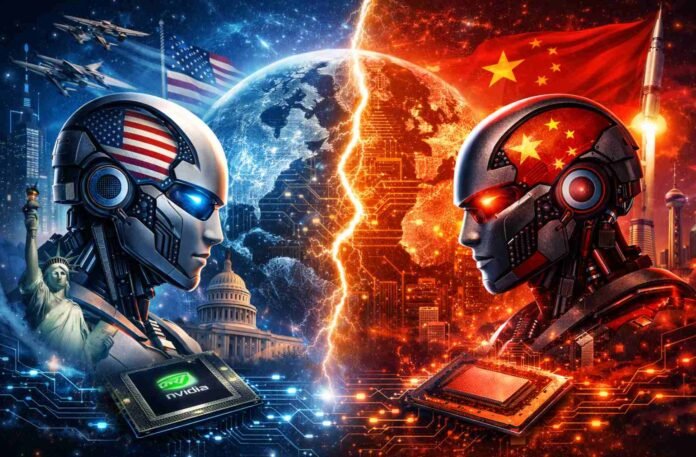
- China is rapidly closing the AI gap with the U.S. through state backing and cost advantages.
- Massive domestic chip clusters and energy access are boosting China’s AI scale.
- Developing nations may favor affordable Chinese tech, creating a parallel tech ecosystem.
- U.S. hyperscalers are spending heavily, but investors question long term returns.
For years, the United States appeared untouchable in artificial intelligence. Silicon Valley set the pace, Nvidia supplied the chips, and American hyperscalers poured billions into building the world’s most powerful AI infrastructure. That dominance now looks less certain.
China’s rapid progress in advanced AI systems is reshaping the competitive landscape. What once seemed like a wide and comfortable U.S. lead is narrowing fast. Analysts warn that this shift is not a short term blip but the beginning of a broader structural realignment in global technology power.
According to Rory Green, chief China economist at TS Lombard, the perception of an American monopoly in AI has already cracked. China, he argues, is not just catching up. It is moving up the value chain at remarkable speed and scale.
More significantly, it is doing so while maintaining cost advantages that could make its technology more attractive to much of the world.
From Fast Follower to Global Contender
China’s strategy goes far beyond building flashy large language models. The country has been steadily developing a vertically integrated tech ecosystem that includes chip design, manufacturing capacity, energy supply and state backed financing.
Beijing’s national AI fund, reportedly worth over 60 billion yuan, underscores the seriousness of that commitment. The broader AI plus initiative aims to weave artificial intelligence across industries, public services and everyday life.
What sets China apart is not only ambition but execution. Huawei’s growing chip clusters and domestic semiconductor efforts show that China is finding ways to work around restrictions while scaling compute power.
NVIDIA may still be considered the gold standard for AI chips, yet Chinese firms are closing the gap by deploying larger volumes of locally produced hardware and leveraging comparatively lower energy costs.
The implications are profound. For the first time, an emerging economy is competing at the cutting edge of science and technology rather than following behind. That psychological shift alone alters how investors, policymakers, and global partners evaluate risk and opportunity.
The Rise of a Parallel Tech Sphere
One of the most significant risks to U.S. dominance is not simply technological parity but geopolitical diffusion. China is already a top trade partner for many emerging and frontier markets. If its AI platforms, telecom infrastructure, and digital services are bundled together at competitive prices, adoption could accelerate quickly.
Developing economies face a pragmatic choice. On one side are lower-cost Chinese solutions that often come with financing and infrastructure support.
On the other are typically more expensive Western alternatives that may carry political or regulatory constraints. For nations without deep security concerns about Beijing, cost efficiency and access to capital can outweigh ideological alignment.
This dynamic could give rise to what some analysts describe as a Chinese tech sphere. In such a scenario, large parts of the global population would rely on Chinese built networks, cloud services, AI systems and hardware.
Over five to ten years, that influence could solidify into a durable ecosystem with its own standards, supply chains and innovation cycles.
America’s Spending Spree Under the Microscope
Meanwhile, U.S. hyperscalers, including Amazon, Microsoft, Meta, and Alphabet, are doubling down. Collectively, they are projected to spend up to 700 billion dollars on AI-related capital expenditure this year alone. The scale is staggering.
Data centers are expanding, custom silicon is being developed and infrastructure build outs are accelerating.
Yet this spending boom has sparked unease among investors. Market volatility earlier this year erased roughly one trillion dollars in tech market value at its peak. Although some losses have been recovered, questions linger about return on investment.
Will the immense capital outlays translate into sustainable profit growth, or is the industry overbuilding in anticipation of demand that may take years to fully materialize?
Karim Moussalem of Selwood Asset Management highlights this tension. The race is clearly on, but the sheer magnitude of spending raises legitimate doubts. Exceptionalism is expensive, and markets are starting to ask whether leadership can be maintained without eroding margins.
A New Phase in the AI Arms Race
None of this means the United States is losing the AI race. American firms still lead in foundational research, cutting edge models and semiconductor innovation. However, the gap appears slimmer than many assumed even two years ago.
Demis Hassabis of Google DeepMind recently suggested that Chinese models may be only months behind Western counterparts.
That assessment changes the narrative. Instead of a clear front runner and a distant challenger, the contest now resembles a high stakes sprint between near equals, each leveraging different structural strengths.
China combines state coordination, manufacturing scale and cost discipline. The U.S. relies on private capital, deep research ecosystems and global talent networks. The outcome will shape not just corporate earnings but digital infrastructure across continents.
What is clear is that the era of unquestioned American dominance in AI is over. The next chapter will be defined by competition, parallel ecosystems and a global market that must choose between them.
Follow TechBSB For More Updates