
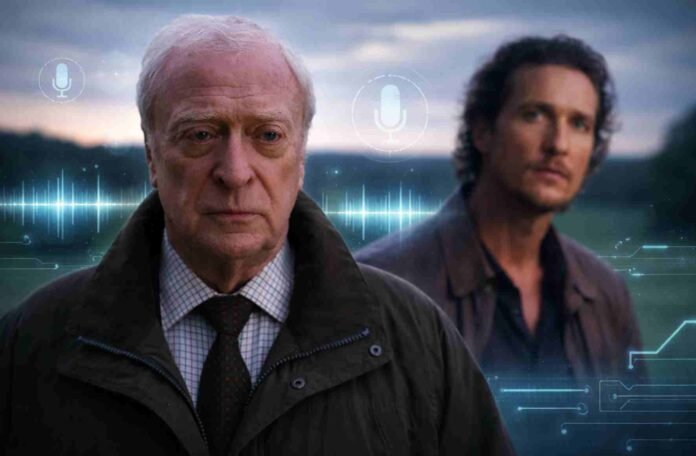
- ElevenLabs now offers licensed celebrity AI voices including Michael Caine and Matthew McConaughey.
- Some voices on the platform belong to deceased figures whose estates approved the licensing.
- AI voice cloning raises ethical concerns about consent, legacy and identity.
- The technology also increases risks of voice based fraud and scams.
Few voices in cinema are as instantly recognizable as those of Michael Caine and Matthew McConaughey. Their tone, cadence and personality have carried films, narrated documentaries and shaped decades of storytelling. Now those voices can be summoned on demand through artificial intelligence.
In March 2026, AI audio company ElevenLabs announced that Michael Caine had officially licensed his voice to the platform. The agreement allows users to hear text read aloud using a digital version of his voice through tools like ElevenReader and the company’s Iconic Marketplace.
McConaughey is also involved with the company, both as a voice partner and an investor. In one example of how the technology can be used, he has employed the system to translate his newsletter into Spanish while preserving the recognizable tone of his own voice.
ElevenLabs says more than two dozen famous voices are already available through its marketplace. The list includes figures such as Judy Garland, Art Garfunkel, Liza Minnelli, Alan Turing and Maya Angelou. Some of these individuals are alive and able to approve such uses themselves. Others are not.
That distinction sits at the center of a growing debate about consent, legacy and the commercialization of identity in the age of artificial intelligence.
The Business of Borrowed Voices
Founded in 2022, ElevenLabs has quickly become one of the most prominent companies working in AI speech generation. Its technology produces voices that closely mimic human tone, emotion and rhythm, often convincingly enough that listeners struggle to tell the difference.
The company’s Iconic Marketplace is designed as a licensing platform. In theory, it allows celebrities or their estates to retain ownership of their voice while granting companies permission to use it for specific projects.
The official framing focuses on consent, control and compensation. Public figures can approve or reject requests, maintain rights over how their voice is used and earn revenue from projects that employ it.
Michael Caine himself described the move as an opportunity to help new storytellers. From that perspective, licensing a voice could be seen as a way to expand creative possibilities while keeping the original performer involved.
For living artists, there is also a practical argument. Voice cloning tools already exist across the internet, many of them operating without permission. Some performers may prefer to license their voice through an official platform rather than allow uncontrolled replicas to circulate.
Still, that explanation only solves part of the problem.
When Consent Becomes Complicated
The presence of deceased figures on the platform raises uncomfortable questions. Maya Angelou, Alan Turing and Judy Garland never approved digital recreations of their voices. Instead, those decisions were made by estates or rights holders.
Legally, that may be permissible. Ethically, it remains unsettled territory.
A voice carries more than sound. It holds cultural meaning, authority and emotional weight. When audiences hear a familiar voice, they also hear decades of context and reputation. Using that voice to narrate a corporate message, educational material or branded content can reshape how people interpret what they hear.
Even when permission exists, the voice itself may end up delivering words the original person never intended to say.
This raises broader questions about digital legacy. Who truly owns a voice after someone dies. And how far should estates be allowed to extend a person’s identity into commercial technology.
The answers are still evolving.
The Trust Problem No One Is Ready For
Beyond celebrity licensing, AI voice technology presents a much more immediate concern. Fraud.
Security experts have been warning about the rapid rise of voice based scams, often called vishing. These schemes use AI generated voices to impersonate someone the victim trusts.
A scammer might clone the voice of a family member, a colleague or a public authority figure. The victim receives a phone call that sounds authentic enough to bypass suspicion. Panic or urgency then pushes them to transfer money or reveal sensitive information.
Industry analysts predict that losses from these scams could reach tens of billions of dollars within the next few years.
What makes voice fraud particularly dangerous is its psychological power. People have learned to distrust suspicious emails and text messages. A familiar voice on the phone still carries instinctive credibility.
The rise of high quality AI voices undermines that instinct.
Security professionals now recommend families and colleagues establish private verification phrases or code words. It is a small but telling sign of how quickly trust in audio communication is eroding.
A Future Where Hearing Is No Longer Believing
AI voice synthesis will continue to spread. The technology is too useful and too profitable to disappear. It can improve accessibility, enable global translation and create new forms of storytelling.
But its normalization may also blur an already fragile line between authentic and artificial communication.
The more people encounter synthetic voices in everyday apps, the harder it becomes to recognize when a voice might not be real.
For companies like ElevenLabs, the business opportunity is enormous. For celebrities, licensing their voice can extend influence and generate income long after the recording booth goes quiet.
For the rest of us, however, the trade off may be something more difficult to measure. Each step forward in voice cloning brings society closer to a moment where even the most familiar voice can no longer be trusted.
And once that line disappears, it may be very difficult to draw it again.
Follow TechBSB For More Updates

